
Which Liquids Are Exempt From TSA's 3-1-1 Rule in 2026?
The TSA's 3-1-1 rule still applies nationwide in 2026, but at airports with CT scanners, 11 categories of liquids and gels are now exempt from the container-size limit. This article explains which items qualify, how to tell if your airport has CT scanners, and the common container-size trap that trips up travelers.
- Carry-on
- CONDITIONAL
- Checked bag
- YES
- Regulating agency
- TSA
- Official source
- View the official TSA rule
Rule last reviewed:
TSA and CBP officers retain final discretion at the checkpoint, even when this verdict is correct.
- YES — allowed
- NO — not allowed
- CONDITIONAL — depends on the details
- CHECKED BAG ONLY — not in carry-on
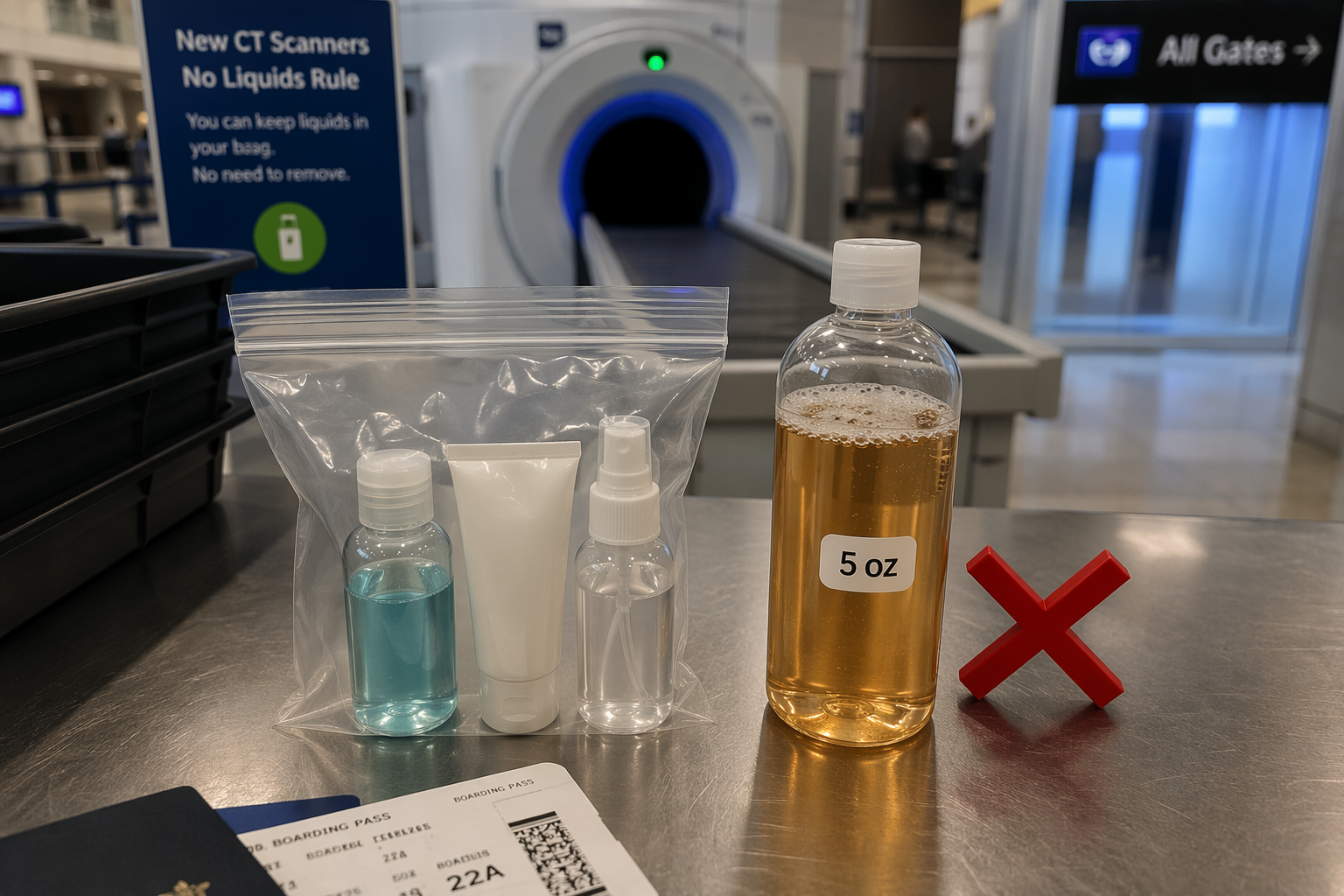
For TSA travel rules in 2026, the safe answer is still conditional: the 3-1-1 liquids rule remains the nationwide carry-on baseline, but some CT-scanner checkpoints may allow larger containers for a narrow set of exempt liquids and gels. The ordinary rule is still 3.4-ounce containers, packed in one quart-size bag, with one bag per traveler. [1]
That means the headline version—“TSA liquids rule changed”—is too loose to pack by. The useful version is: if your item is in one of the exempt categories and you are screened at a CT-equipped checkpoint, the container-size limit may not apply. If either condition is missing, pack as if the old 3-1-1 rule will be enforced.
The 11 Liquid Categories Reported as Exempt at CT-Scanner Checkpoints
Travelopod’s June 2026 summary lists 11 liquid or gel categories as exempt from the 3-1-1 container-size limit at CT-scanner airports, while TSA’s own main liquids page still presents the general 3-1-1 rule as the baseline. For packing purposes, treat this list as a CT-checkpoint exception layer, not as a nationwide repeal of the liquids rule. [1][2]
| Exempt category | What to watch at the checkpoint |
|---|---|
| Prescription medications | Keep them accessible and expect separate screening if an officer asks. |
| Over-the-counter medicines | Larger containers may qualify at CT-equipped checkpoints, but they should still be presented clearly. |
| Ice packs or gel packs for medical use | The medical purpose matters; do not assume every cooling pack is treated the same way. |
| Breast milk and formula | These are family-relevant liquids, not ordinary toiletries. |
| Baby food | Pack it where it can be inspected without unpacking the entire bag. |
| Liquid-filled teethers | This is a baby-care exception, not a general exemption for liquid-filled items. |
| Live fish | The water is tied to transporting the live animal. |
| Biological samples | Expect closer inspection and documentation questions depending on the sample. |
| Wet batteries | Battery rules can involve safety handling beyond the liquids issue. |
| Duty-free purchases within 48 hours | Keep the item sealed and keep the receipt available. |
| Fresh eggs | Unusual, but listed as part of the reported exemption set. |
Several of these categories are familiar from TSA’s item-specific guidance, especially medications, baby supplies, live fish, and duty-free liquids. The point is not that every bottle in your bag has become harmless; it is that these categories are screened differently from routine toiletries when the checkpoint has the equipment and the officer accepts the item for that process. [2][3]
How the Two-Tier Liquids System Works
CT scanners matter because they give officers 3D imaging of a bag and its contents, which can make it easier to inspect certain larger liquid containers without reducing every item to travel-size packaging. [2]
The exemption belongs to the checkpoint, not to you for the whole trip. If you depart from a CT-equipped lane with a qualifying medication, formula container, or sealed duty-free purchase, that does not guarantee the same item will pass unchanged through a later airport, a non-CT checkpoint, or an international connection where standard 3-1-1 screening is applied again.
Travelopod identifies major hubs including ATL, JFK, and LAX as examples of airports with CT scanners, but deployment is not the same thing as a promise that every lane, terminal, or screening moment will use CT equipment. [2] If your plan depends on the exception, check the airport’s current security information before you pack, and still be ready for an officer to send the item through additional screening.
A practical order of operations works better than guessing from the label on the bottle:
- Decide whether the item fits one of the 11 exempt categories.
- Check whether your departure checkpoint is using CT screening.
- Look ahead to any later checkpoint or international connection.
- If the route includes uncertainty, pack the item in checked baggage or keep it within 3.4 ounces.
The Container-Size Trap Still Catches People
At a standard 3-1-1 checkpoint, the limit is based on the container size, not how much liquid is left inside. A half-full 5-ounce shampoo bottle is still a 5-ounce container, so it does not become compliant just because you used most of it before the trip. [4]
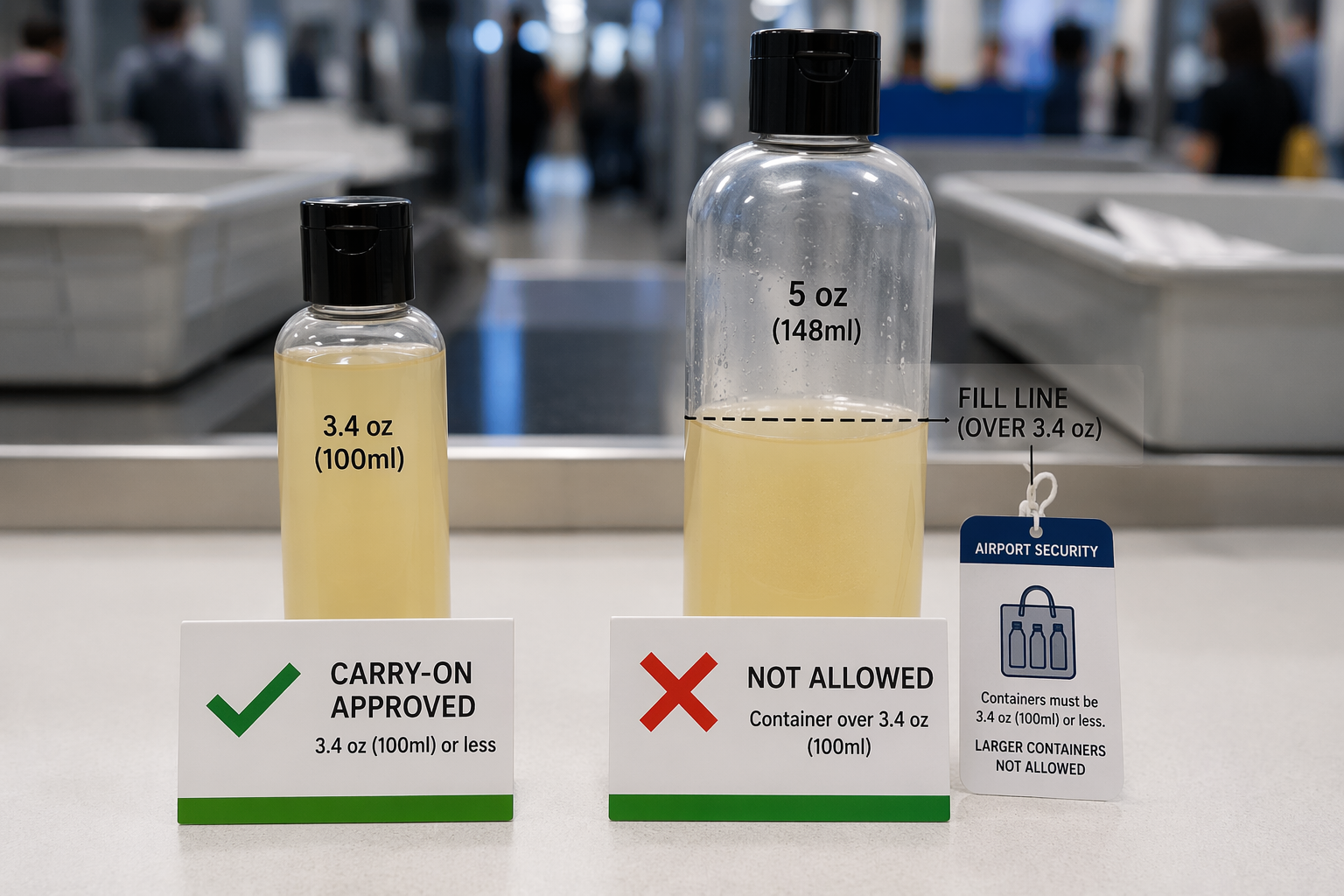
This is the mistake that burns time at the bin table. Someone packs a nearly empty oversized conditioner, sunscreen, or face wash because it “only has a little left,” then has to choose between surrendering it, checking a bag, or leaving the line if that option is still available. The rule does not ask how much product remains; it asks what the container can hold.
The CT exception does not turn that oversized toiletry into an exempt item. Unless the item itself falls into one of the qualifying categories, a larger bottle of shampoo, moisturizer, shaving cream, or hair gel should be treated as a checked-bag item or repacked into a compliant travel container.
Items That Count as Liquids More Often Than Travelers Expect
TSA’s liquids rule covers more than drinks. If an item pours, squeezes, spreads, smears, pumps, or sprays, it can fall under the liquids, aerosols, and gels rule. [1][4]
| Item | How to pack it under the baseline rule |
|---|---|
| Moisturizer | Use a 3.4-ounce or smaller container in the quart-size bag. |
| Sunscreen | Use travel size for carry-on unless it qualifies under a separate medical need. |
| Foundation | Liquid and cream makeup should be treated as a liquid or gel. |
| Hair gel | Pack in the liquids bag if carried on. |
| Shaving cream | Treat as an aerosol or foam under the liquids rule. |
| Lip gloss | Pack with liquids if it is a gel or squeezable gloss. |
| Aerosol dry shampoo | Keep it travel-size for carry-on. |
| Peanut butter | Treat as a spread, not as a solid snack. |
| Creamy cheese | Treat as a spreadable food item. |
| Gel packs | Only medical-use gel packs belong in the exemption discussion. |
This is where many packing decisions become simple. A prescription liquid medicine is in a different bucket from a favorite salon-size conditioner. Formula is in a different bucket from a large iced coffee. A medical gel pack is not the same packing problem as a cosmetic cooling mask.
Duty-Free Liquids Need Their Own Check
Duty-free liquids are one of the reported exempt categories, but the useful detail is the condition: Travelopod lists duty-free purchases within 48 hours among the 11 categories, and TSA item guidance has long treated properly packaged duty-free liquids differently from ordinary open bottles. [2][3]
Do not open the sealed duty-free bag before screening. Keep the receipt with the purchase. If you have a connection, especially an international one, assume the next checkpoint may care about packaging, timing, and local screening rules rather than the fact that the item passed somewhere else.
What to Do If You Are Packing Right Now
Start with the nationwide baseline. Put ordinary toiletries and spreadable foods in containers of 3.4 ounces or less, inside one quart-size bag, one per traveler. For the full baseline rule, use Your Complete Guide to the TSA Liquids Rules for 2026 as the general reference.
Then separate the possible exceptions: medication, baby supplies, medical ice or gel packs, biological or live-animal liquids, wet batteries, sealed duty-free purchases, and the other categories listed above. Keep those items easy to remove or identify. If the checkpoint has CT screening, larger containers may be allowed. If it does not, or if a later checkpoint may screen you again under ordinary rules, the safer packing choice is 3-1-1 sizing or checked baggage.
One final checkpoint reality matters: TSA officers retain final discretion. If the airport and item both qualify, larger exempt liquids may pass; if either condition is missing, pack for 3-1-1 or check the bag.
References
- Liquids, Aerosols, and Gels Rule, TSA.gov.
- TSA's New Security Rules 2026: 11 Exempt Liquid Items, Travelopod, Jun 2026.
- What Can I Bring?, TSA.gov.
- The TSA Personal Care Packing Mistakes You Need To Stop Making In 2026, Forbes, May 2026.
See something outdated?
If this verdict, citation, or figure looks out of date, let us know. Report a correction.