
Your Complete Guide to the TSA Liquids Rules for 2026
The TSA 3-1-1 liquids rule remains unchanged in 2026 despite CT scanner rollouts. This guide explains container limits, bag requirements, what counts as a liquid, and how screening varies by airport so you can pack confidently.
TSA · Applies to: Both
Rule last reviewed:
As of Q3 2026, the TSA liquid rules for carry-ons have not changed: liquids, aerosols, gels, creams, and pastes must follow the 3-1-1 rule. That means each container must be 3.4 oz or 100 ml or smaller, all of those containers must fit in one clear quart-sized zip-top bag, and each passenger gets one such bag in carry-on luggage.[1]
- Last reviewed for 2026: the rule is still in effect nationwide.
- Regulating agency: Transportation Security Administration, or TSA.
- Core limit: 3.4 oz / 100 ml per container, not per product.
- Final checkpoint decision: TSA officers may still decide whether an item can pass through screening.[2]
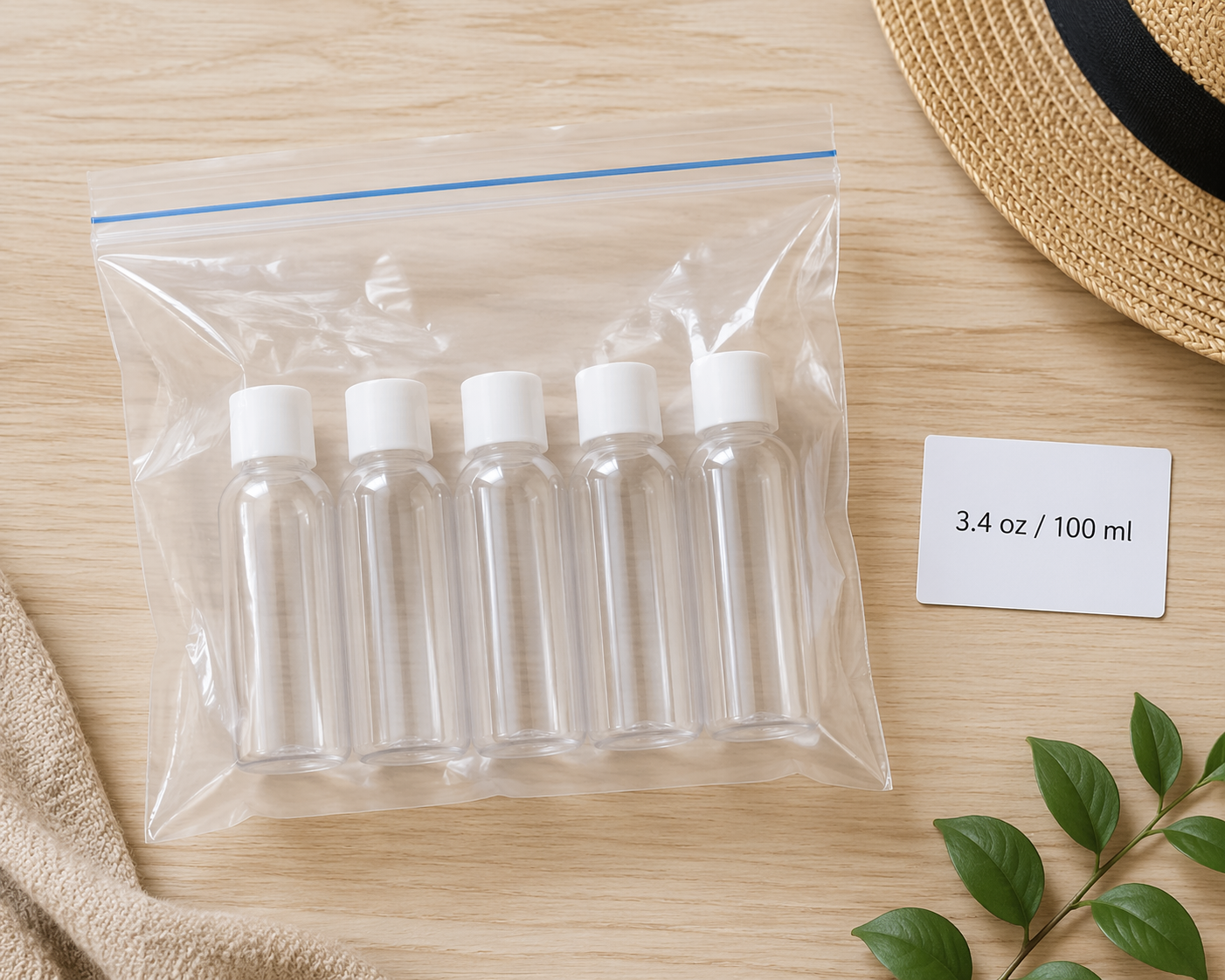
The part that causes trouble in 2026 is not the rule itself. It is the checkpoint experience. Some airports have newer CT scanners, and some travelers no longer have to remove the liquids bag from their carry-on. That is a screening procedure change, not permission to pack larger bottles.
The 3-1-1 Rule, Without the Packing Folklore
The TSA’s 3-1-1 rule has three separate requirements. A carry-on item can fail any one of them.
| Part of the rule | What it means |
|---|---|
| 3.4 oz / 100 ml | Each liquid, aerosol, gel, cream, or paste container must be 3.4 oz / 100 ml or smaller. |
| 1 quart-sized bag | All travel-size containers must fit inside one clear quart-sized zip-top bag. |
| 1 bag per passenger | Each passenger may bring one liquids bag in carry-on luggage. |
The container-size point deserves its own warning because it is the easiest one to misunderstand. TSA looks at the size marked on the container, not how much product is left inside. A half-empty 6 oz sunscreen bottle is still over the carry-on limit, even if there is less than 3.4 oz of sunscreen sloshing around at the bottom.[1]
That can feel petty at the checkpoint, but it is also why the rule is relatively simple for officers to enforce. They do not have to estimate what remains in a bottle. They look at the container.
Pack by Container First, Then by Bag Space
Start with every item that could be liquid, gel, cream, paste, aerosol, spreadable, squeezable, or pourable. Check the printed container size. If the container is larger than 3.4 oz / 100 ml, it does not belong in your carry-on liquids bag unless it falls under a specific TSA allowance, such as certain medically necessary items or qualifying duty-free liquids.[1][2]
Next, put the compliant containers into one clear quart-sized zip-top bag. The rule does not say you can bring unlimited tiny bottles scattered across a dopp kit, purse, stroller pocket, and backpack. They need to fit in the one bag assigned to that passenger.[1]
If the bag will not close without a wrestling match, treat that as a packing problem, not a checkpoint negotiation. Move lower-priority items to checked luggage, buy them after security, or switch to solid versions where that actually makes sense.
What Counts as a Liquid Is Broader Than Most People Expect
TSA’s liquids rule covers more than watery things. In practice, the test is whether the substance is spreadable, squeezable, or pourable. TSA’s item-level guidance and travel explainers updated for 2026 place many everyday foods and toiletries on the liquids side of the line, even when they do not look like a drink.[2][3]
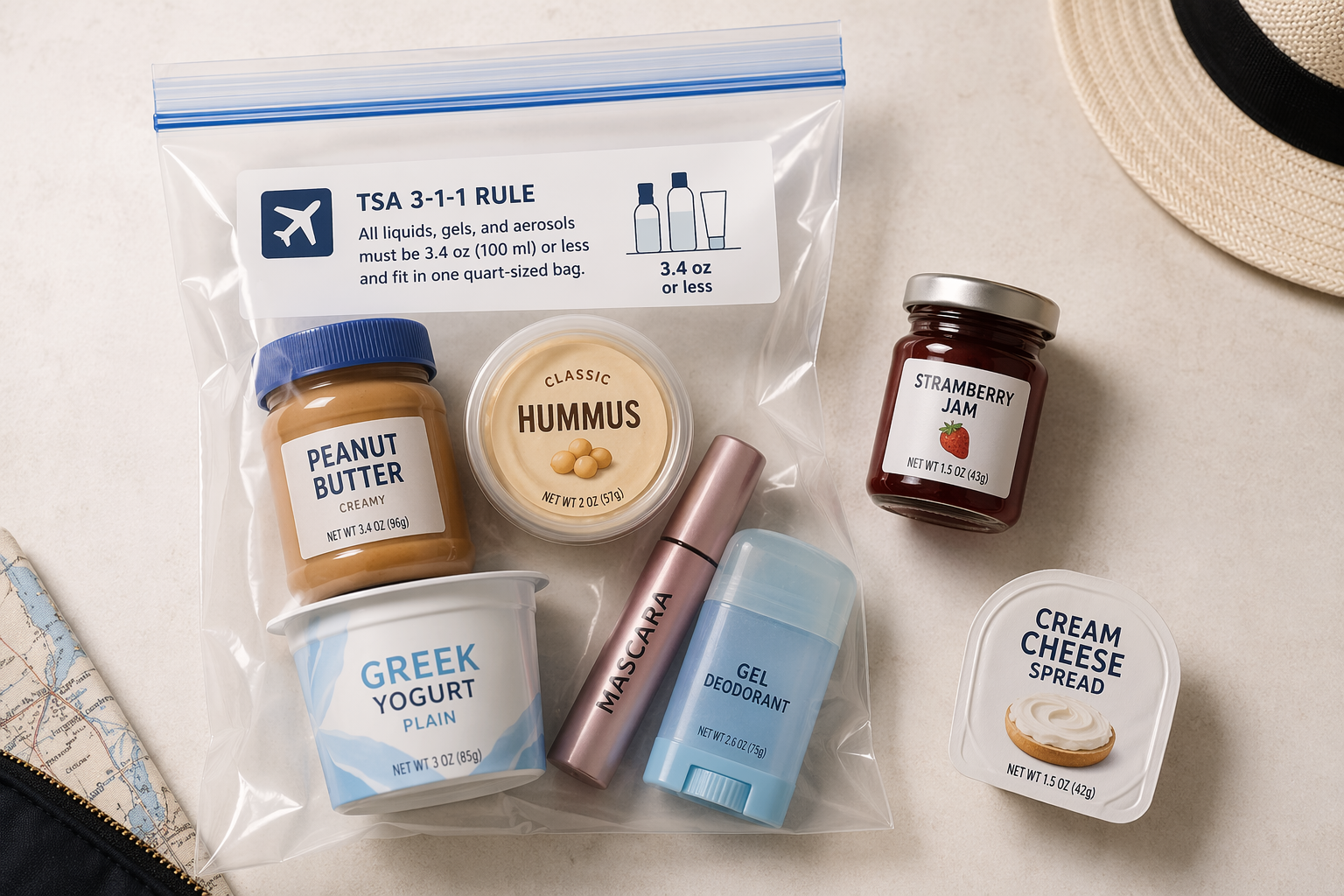
These are the kinds of items that catch careful packers off guard:
- Peanut butter and similar nut spreads
- Hummus
- Yogurt
- Nutella and other chocolate-hazelnut spreads
- Mascara
- Gel deodorant
- Cream cheese
- Jam and jelly
- Canned or jarred foods packed in liquid, such as soup or olives in brine
The food examples are where the rule feels least intuitive. A sealed jar of peanut butter can look like a snack, not a liquid. A container of hummus can look like lunch, not a gel. But if it spreads, squeezes, or pours, pack it under 3.4 oz / 100 ml in the quart bag or put it in checked luggage.[2][3]
Makeup follows the same practical logic. Mascara goes in the liquids bag. Lip gloss generally belongs there too. Standard lipstick, however, is treated differently because it is a solid stick rather than a liquid or gel-style product.[2][3]
Solids Can Skip the Liquids Bag
True solids do not need to use space in the quart bag. That is useful if your liquids bag is already full or if you want fewer checkpoint variables.
- Solid deodorant
- Shampoo bars
- Toothpaste tablets or tooth powder
- Bar soap
- Solid perfume
- Standard lipstick, not lip gloss
- Dry snacks
This is often the cleanest fix for short trips. A shampoo bar, bar soap, and toothpaste tablets can remove three items from the quart bag without asking a TSA officer to make a close call.
CT Scanners Change What You Remove, Not What You Pack
Newer CT scanners are a real reason travelers are getting mixed signals. As of the latest available TSA data cited in September 2025, Forbes reported CT scanners at about 285 of 435 U.S. airports with checkpoints, with about 1,027 units deployed.[4] TSA also announced a $1.3 billion contract in April 2023 to procure additional CT X-ray scanners for airport checkpoints.[5]
At some CT-equipped lanes, officers may tell passengers to leave liquids inside the carry-on. That instruction is about how the bag is screened. It does not erase the 3.4 oz / 100 ml container limit, the quart-bag requirement, or the one-bag-per-passenger rule.
This is the checkpoint sentence worth remembering: if an officer says, “leave everything in your bag,” that does not mean, “a full-size bottle is allowed.” It means the scanner may be able to inspect the packed bag without you separating items into bins.
The national rule has not caught up to the most optimistic airport anecdotes. One former airport security director quoted by Forbes estimated a roughly 10-year timeline for nationwide CT deployment, but that was an expert estimate, not an official TSA rule-change date.[4]
TSA PreCheck Does Not Waive Liquid Limits
TSA PreCheck can make the screening process easier, but it does not create a separate liquid allowance. A PreCheck traveler still needs 3.4 oz / 100 ml containers, one clear quart-sized bag, and one liquids bag per passenger under the carry-on rule.[1]
PreCheck confusion usually comes from the same place as CT-scanner confusion: fewer things may need to come out of the bag. Fewer removals do not mean larger liquids.
Hand Sanitizer Is Back Under the Ordinary Rule
The temporary pandemic-era allowance for larger hand sanitizer containers ended in May 2023. For 2026 carry-on packing, hand sanitizer belongs under the standard 3-1-1 rule: 3.4 oz / 100 ml or smaller, packed in the quart-sized liquids bag.[3]
If you still have an old 8 oz or 12 oz sanitizer bottle in a travel drawer, do not treat it as grandfathered. Put a travel-size bottle in the liquids bag or pack the larger one in checked luggage.
Duty-Free Liquids Have a Narrow Exception
Duty-free liquids over 3.4 oz can be allowed in carry-on bags only under specific conditions for inbound international travel: they must be packed by the retailer in a secure, tamper-evident bag, show no signs of tampering, and be accompanied by the original receipt showing the purchase was made within 48 hours.[6]
That exception is not a general permission slip for full-size liquids. It is built around a sealed retail bag and a recent receipt. If you open the bag, lose the receipt, or try to add another bottle, you have made the officer’s job harder and your own outcome less predictable.
Exceptions Are Item-Level Allowances, Not a Free-for-All
Some items may be allowed outside the ordinary 3-1-1 limits, especially when TSA lists a specific item allowance or when an item is medically necessary. But those allowances are item-specific. They are not a single magic category called “exempt liquids” that covers anything important, expensive, or inconvenient to replace.[2]
If an item matters enough that losing it would disrupt the trip, check TSA’s item-level guidance before you pack. Then keep it accessible. Even when an item is allowed, TSA may require additional screening, and the officer at the checkpoint has the final call.[2]
What to Do With Borderline Items
For borderline items, do not try to win a vocabulary argument at the belt. Use the physical test: can it spread, squeeze, smear, gel, pour, spray, or flow? If yes, keep it in a 3.4 oz / 100 ml or smaller container inside the quart bag, unless you have confirmed a specific TSA allowance.
For example, imagine packing breakfast for an early flight. A dry granola bar can stay in your personal item. A small sealed yogurt cup belongs in the liquids bag if it meets the size limit. A larger yogurt cup should go in checked baggage or be eaten before security. The difference is not whether the item is food; it is whether TSA treats its form as liquid, gel, cream, or spreadable.
About Rumored TSA Liquid Rule Changes
There has been public discussion about possible future changes. In July 2025, NBC News/AP reported Homeland Security Secretary Kristi Noem saying that liquids “may be the next big announcement” after changes to shoe-removal screening.[7] That is interesting background. It is not a published TSA rule change.
Until TSA publishes an actual update, pack for the rule that exists. That means small containers, one clear quart bag, one bag per passenger, and no reliance on PreCheck, CT scanners, or a friend’s recent airport story to make a full-size bottle compliant.
References
- Liquids, Aerosols, and Gels Rule, TSA.gov
- What Can I Bring?, TSA.gov
- The TSA’s 3-1-1 Rule for Liquids in Carry-On Luggage, AFAR, updated May 2026
- TSA Phasing Out Liquid Rules, Forbes, September 2025
- TSA awards $1.3 billion to procure additional CT X-ray scanners for airport checkpoints, TSA.gov, April 12, 2023
- Liquids, aerosols and gels rule, TSA.gov
- First shoes went back on. Now US airport security liquid carry-ons may be handled next, NBC News/AP
Spotted something outdated?
Report a correction if this explainer no longer matches the current rule. Report a correction.