
The Simple Rule for Bringing Food on a Plane
Solid foods are always allowed through TSA security; liquids, gels, and spreads are limited to 3.4 oz containers. This page explains the essential rule, lists common food items with their carry-on and checked verdicts, and covers special cases like baby formula, ice packs, and frozen food.
- Carry-on
- CONDITIONAL
- Checked bag
- YES
- Regulating agency
- TSA
- Official source
- View the official TSA rule
Rule last reviewed:
TSA and CBP officers retain final discretion at the checkpoint, even when this verdict is correct.
- YES — allowed
- NO — not allowed
- CONDITIONAL — depends on the details
- CHECKED BAG ONLY — not in carry-on
Yes, you can bring food on a plane through TSA security, but the useful answer is conditional: solid food can go in carry-on or checked bags; liquids, gels, creams, and spreadable foods in carry-on bags must follow the 3.4 oz, quart-bag liquids rule. TSA states the solid-food rule directly: “Solid food items (not liquids or gels) can be transported in either your carry-on or checked bags.”[1] TSA’s separate 3-1-1 rule limits liquids, aerosols, gels, creams, and pastes in carry-on bags to containers of 3.4 oz or less, packed in one quart-sized bag.[2]
That is the whole checkpoint test for most food: what state is it in when it reaches screening? A sandwich is a solid. Peanut butter is a spread. A frozen casserole may be fine while frozen solid, but it becomes a problem if it is partly melted or slushy. TSA also makes clear that the final decision rests with the TSA officer at the checkpoint, so the rule is strong enough to pack by, but not a guarantee against extra screening.[1]
The Texture Rule That Answers Most Food Questions
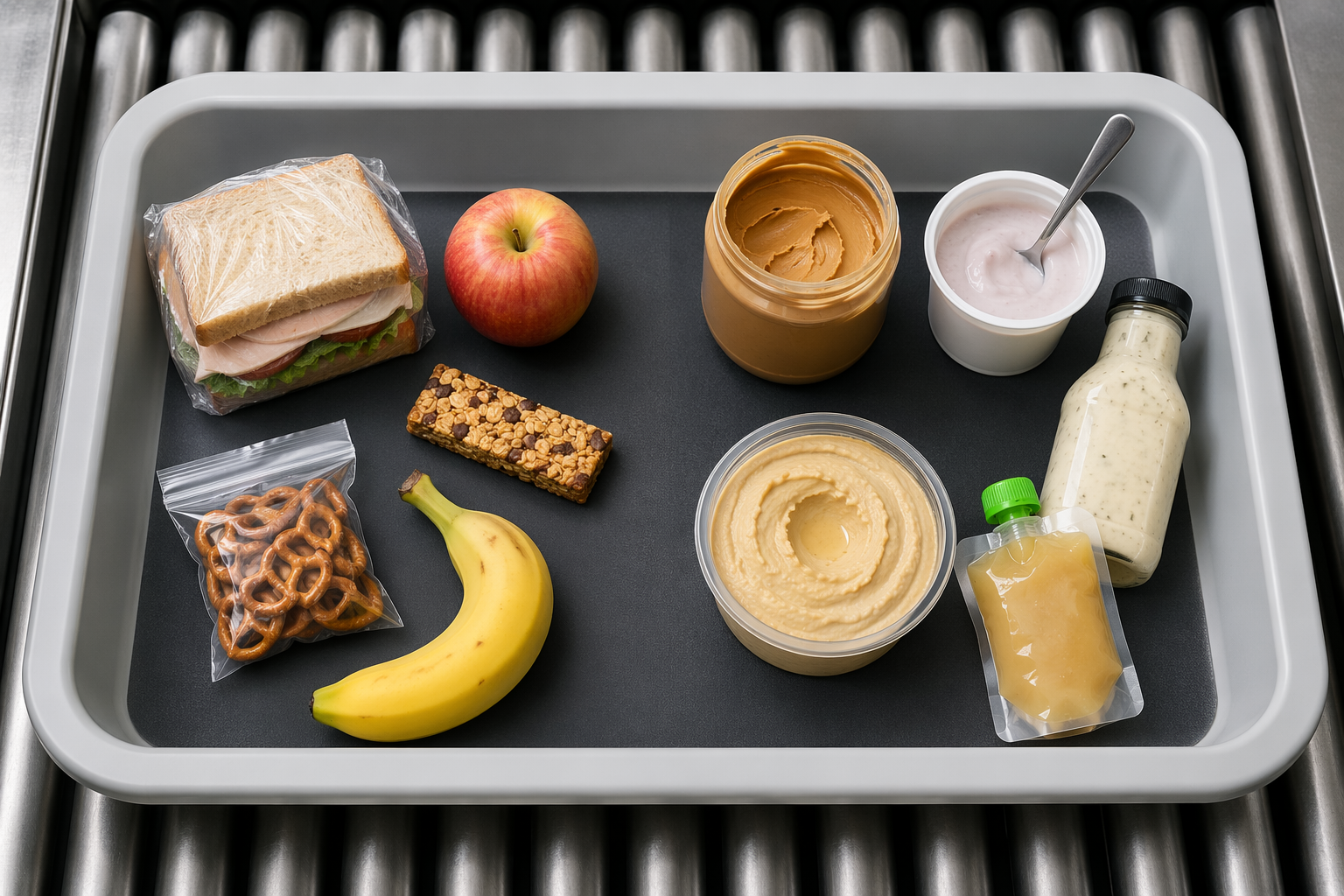
Do not sort food by whether it is breakfast, a snack, homemade, sealed, expensive, or “real food.” Sort it by texture. If it keeps its shape as a solid item, TSA generally allows it in both carry-on and checked baggage. If it pours, spreads, smears, gels, creams, or behaves like a liquid, it belongs under the 3-1-1 liquids rule unless a specific exception applies.[1][2]
TSA’s food FAQ gives the same practical direction: food may be packed in carry-on or checked bags, but liquid or gel food items larger than 3.4 oz should go in checked bags if possible.[3] That “if possible” matters. A full jar of jam, a large tub of hummus, a soup container, or a family-size yogurt is not rescued by being edible.
| Food item | Carry-on through TSA | Checked bag | Why |
|---|---|---|---|
| Sandwich or wrap | Allowed | Allowed | Solid food |
| Bread, bagels, muffins, pastries | Allowed | Allowed | Solid food |
| Crackers, chips, pretzels, popcorn | Allowed | Allowed | Solid food |
| Granola bars or protein bars | Allowed | Allowed | Solid food |
| Cookies, candy, chocolate | Allowed | Allowed | Solid food; melted chocolate may be treated differently if it becomes liquid-like |
| Fresh fruit such as apples, bananas, oranges | Allowed on domestic TSA screening | Allowed on domestic TSA screening | Solid food; customs rules may apply on international trips |
| Raw vegetables or cut vegetables | Allowed on domestic TSA screening | Allowed on domestic TSA screening | Solid food; dips are separate |
| Cheese block or sliced cheese | Allowed | Allowed | Solid food |
| Hard-boiled eggs | Allowed | Allowed | Solid food |
| Cooked meat, chicken, or leftovers without sauce | Allowed | Allowed | Solid food; pack to avoid spills and odors |
| Pizza slices | Allowed | Allowed | Solid food |
| Dry cereal or trail mix | Allowed | Allowed | Solid food |
| Nuts and dried fruit | Allowed | Allowed | Solid food; international agriculture rules may apply |
| Cake or pie | Allowed, but may need extra screening | Allowed | Generally solid, though soft fillings can attract attention |
| Peanut butter or other nut butter | Allowed only if each container is 3.4 oz or less and fits in the quart bag | Allowed | Spread |
| Hummus | Allowed only if each container is 3.4 oz or less and fits in the quart bag | Allowed | Spread or dip |
| Cream cheese or soft cheese spread | Allowed only if each container is 3.4 oz or less and fits in the quart bag | Allowed | Spreadable cream |
| Jam, jelly, preserves, honey, syrup | Allowed only if each container is 3.4 oz or less and fits in the quart bag | Allowed | Gel, liquid, or spread |
| Yogurt | Allowed only if each container is 3.4 oz or less and fits in the quart bag | Allowed | Gel or liquid food |
| Applesauce or fruit pouch | Allowed only if each container is 3.4 oz or less, unless covered by a child-related exception | Allowed | Puree or gel |
| Salad dressing, salsa, gravy, sauces | Allowed only if each container is 3.4 oz or less and fits in the quart bag | Allowed | Liquid, gel, or sauce |
| Soup or broth | Allowed only if each container is 3.4 oz or less and fits in the quart bag | Allowed | Liquid |
| Dips such as queso or ranch dip | Allowed only if each container is 3.4 oz or less and fits in the quart bag | Allowed | Dip or spread |
| Canned food | May be allowed, but often a poor carry-on choice | Allowed | Can resemble liquid or dense contents and may need extra screening |
| Frozen food | Allowed if frozen solid at screening | Allowed | If partly melted, slushy, or liquid is present, the liquids rule can apply |
| Gel ice pack | Allowed if frozen solid at screening; otherwise subject to the liquids rule unless needed for medically necessary items | Allowed | Gel item judged by state at screening |
| Powdered drink mix, protein powder, spices | Allowed, but may need extra screening | Allowed | Powder, not a liquid; larger or unclear containers can slow screening |
| Baby formula, breast milk, toddler drinks, baby food | Allowed in quantities TSA describes as reasonable | Allowed | Medically necessary or child-related exception; present separately for screening |
Spreads Count as Liquids Even When They Do Not Spill
The food items that surprise travelers are usually not drinks. They are peanut butter, hummus, cream cheese, jam, honey, salsa, frosting, yogurt, and dressing. They sit in jars and tubs, so they feel more like groceries than liquids. TSA screens them by texture, not by grocery aisle.
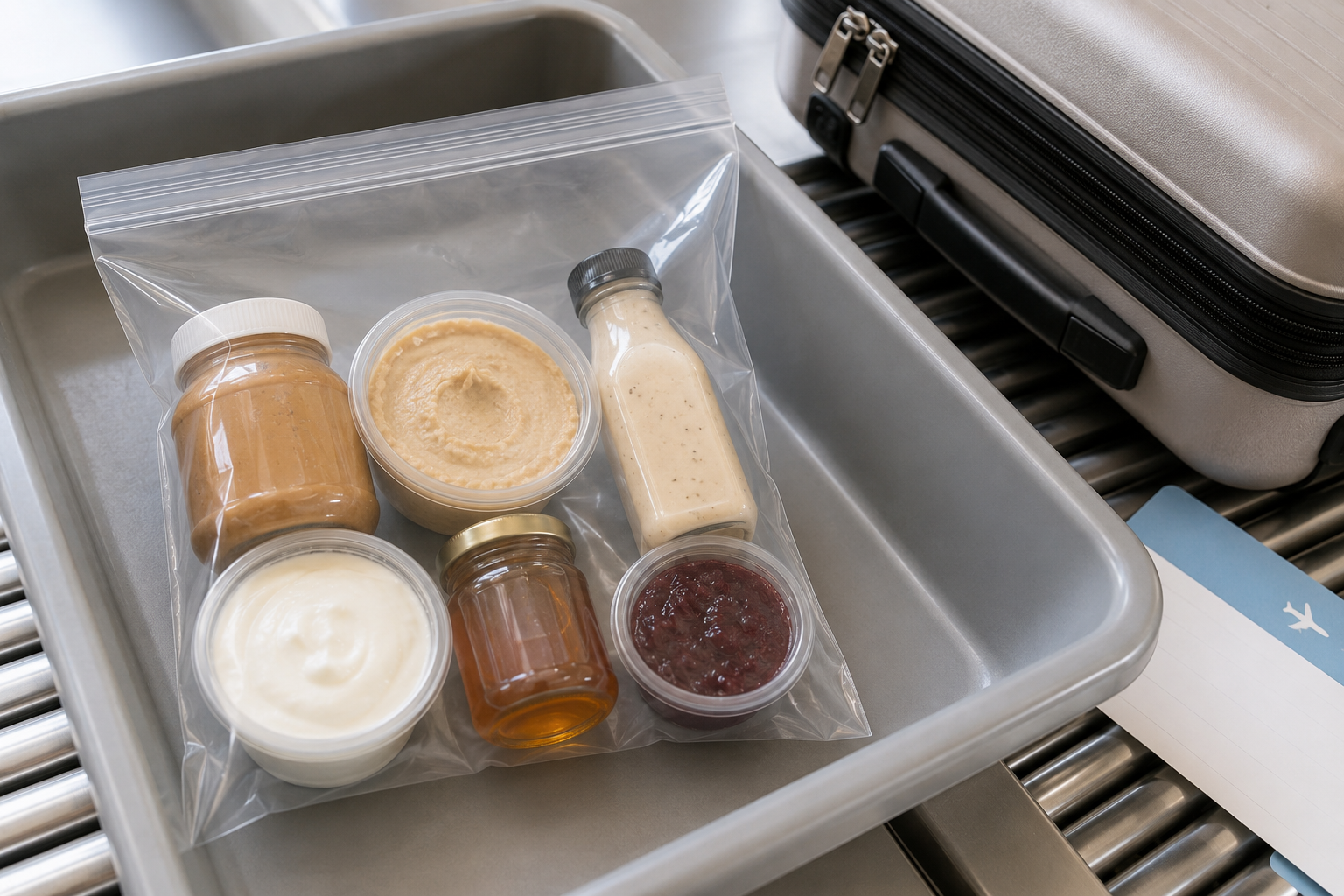
For carry-on packing, use the same rule you would use for shampoo: each container must be 3.4 oz or smaller, and all of those containers must fit in one quart-sized bag.[2] A mostly empty 12 oz jar is still a 12 oz container. If you want to bring a larger jar, tub, pouch, or bottle, put it in checked luggage.
Baby Formula, Breast Milk, and Baby Food Are Different
Baby formula, breast milk, toddler drinks, and baby or toddler food are not limited to 3.4 oz when TSA treats them as medically necessary liquids. TSA says these items are allowed in “reasonable quantities,” and they do not need to fit inside the quart-sized liquids bag.[4]
The annoying part is that TSA does not define “reasonable quantities” with a number. Pack what is actually needed for the trip, separate it from the rest of the bag before screening, and tell the officer you are carrying baby or medically necessary liquids. TSA may screen these items separately.[4]
This exception is protective, not unlimited. It helps a parent carrying formula, breast milk, puree pouches, or cooling accessories for those items. It does not turn every family snack into an exception from the liquids rule.
Frozen Food and Ice Packs Depend on Their State at Screening
Frozen food is allowed in carry-on and checked bags if it is frozen solid when presented for screening. If the food is partially melted, slushy, or has liquid at the bottom of the container, it must meet the 3-1-1 liquids requirements to travel in a carry-on bag.[5]
Gel ice packs follow the same practical test. TSA allows them when they are frozen solid at screening. If they are melted or partly melted, they are treated under the liquids rule unless they are needed to cool medically necessary items.[6]
That means the freezer is not just about keeping food cold; it is part of the screening plan. A rock-solid ice pack is easy to classify. A soft, bendable, sweating gel pack invites the liquids rule.
Canned Foods, Powders, and Dense Containers
Canned foods sit in the gray area where “may be allowed” and “good idea” are not the same thing. A sealed can may contain liquid, gel, dense food, or a combination that is hard to identify on the X-ray. TSA’s general rule still applies, but a can in a carry-on can slow down screening or be disallowed if the officer cannot clear it.
Powders are not liquids, so the 3.4 oz container rule is not the issue. Protein powder, powdered drink mix, spices, and similar dry foods can still receive extra screening if the container is large, unlabeled, or difficult to inspect. If the item is not needed during the flight, checked baggage is usually the cleaner choice.
TSA Clearance Is Not Customs Clearance
For domestic U.S. security screening, TSA is the relevant agency. For international travel, the food question does not end at the checkpoint. U.S. Customs and Border Protection regulates agricultural products brought into the United States, and its guidance covers meats, fruits, vegetables, plants, seeds, soil, and other items that may carry pest or disease risks.[7]
So a snack may be acceptable through TSA before departure and still be restricted when entering another country, or when returning to the United States. Travelers departing from non-U.S. airports also face that airport’s screening rules, not TSA’s. The texture rule is a U.S. TSA rule, not a worldwide customs rule.
How to Pack Food So the Rule Works in Your Favor
- Put obvious solid foods together: sandwiches, bars, fruit, crackers, bread, and dry snacks are the easiest items to clear.
- Treat spreads and sauces like toiletries: use containers of 3.4 oz or less and pack them in the quart bag if they are going in a carry-on.
- Use checked baggage for larger jars, tubs, cans, soups, sauces, dressings, and dips whenever possible.
- Freeze gel packs and frozen food solid before leaving for the airport, and remember that their state at screening is what matters.
- Separate baby formula, breast milk, toddler drinks, and baby food before screening and tell the officer they are medically necessary or child-related items.
- Keep questionable foods accessible. If an officer needs a closer look, you do not want to unpack the whole carry-on at the conveyor belt.
If you can classify the food by texture, you can usually choose the right bag. Solid snack or meal: carry-on is fine. Spread, dip, sauce, yogurt, soup, or puree: 3.4 oz carry-on container or checked bag. Frozen item or ice pack: frozen solid at screening or expect the liquids rule. Baby formula and breast milk: use the TSA child-travel exception, but do not expect a published numeric limit.
For an item that still feels borderline, check TSA’s official “What Can I Bring?” food page before packing and leave room for the officer’s final decision at the checkpoint.[1]
References
- Food, Transportation Security Administration, https://www.tsa.gov/travel/security-screening/whatcanibring/food
- Liquids, Aerosols, and Gels Rule, Transportation Security Administration, https://www.tsa.gov/travel/security-screening/liquids-aerosols-gels-rule
- May I pack food in my carry-on or checked bag?, Transportation Security Administration, https://www.tsa.gov/travel/frequently-asked-questions/may-i-pack-food-my-carry-or-checked-bag
- Traveling with Children, Transportation Security Administration, https://www.tsa.gov/travel/special-procedures/traveling-children
- Frozen Food, Transportation Security Administration, 2017, https://www.tsa.gov/items/frozen-food
- Gel Ice Packs, Transportation Security Administration, 2022, https://www.tsa.gov/items/gel-ice-packs
- Bringing Agricultural Products Into the United States, U.S. Customs and Border Protection, June 11, 2026, https://www.cbp.gov/travel/clearing-cbp/bringing-agricultural-products-united-states
See something outdated?
If this verdict, citation, or figure looks out of date, let us know. Report a correction.