
What Is the TSA 3-1-1 Rule? A Complete Guide for 2026
The TSA 3-1-1 rule limits carry-on liquids to 3.4 oz containers in one quart-size bag per passenger. Learn exactly what counts as a liquid, which items are exempt, and how to pack without stress in 2026.
TSA · Applies to: Both
Rule last reviewed:
Last reviewed for Q3 2026: the TSA 3-1-1 rule still means each carry-on liquid, aerosol, gel, cream, or paste must be in a container of 3.4 ounces or 100 milliliters or less; all of those containers must fit in one clear quart-size zip-top bag; and each passenger gets one such bag.[1] The awkward part is still the part printed on the bottle: a half-empty 6-ounce shampoo bottle does not pass just because only a little shampoo is left inside.[2]
Pack for the rule as written, even if you have heard that newer airport scanners can handle more. TSA officers make the final decision at the checkpoint, and the safest packing standard in 2026 is still the plain one: compliant containers, one sealable quart bag, exemptions separated when needed.[1]
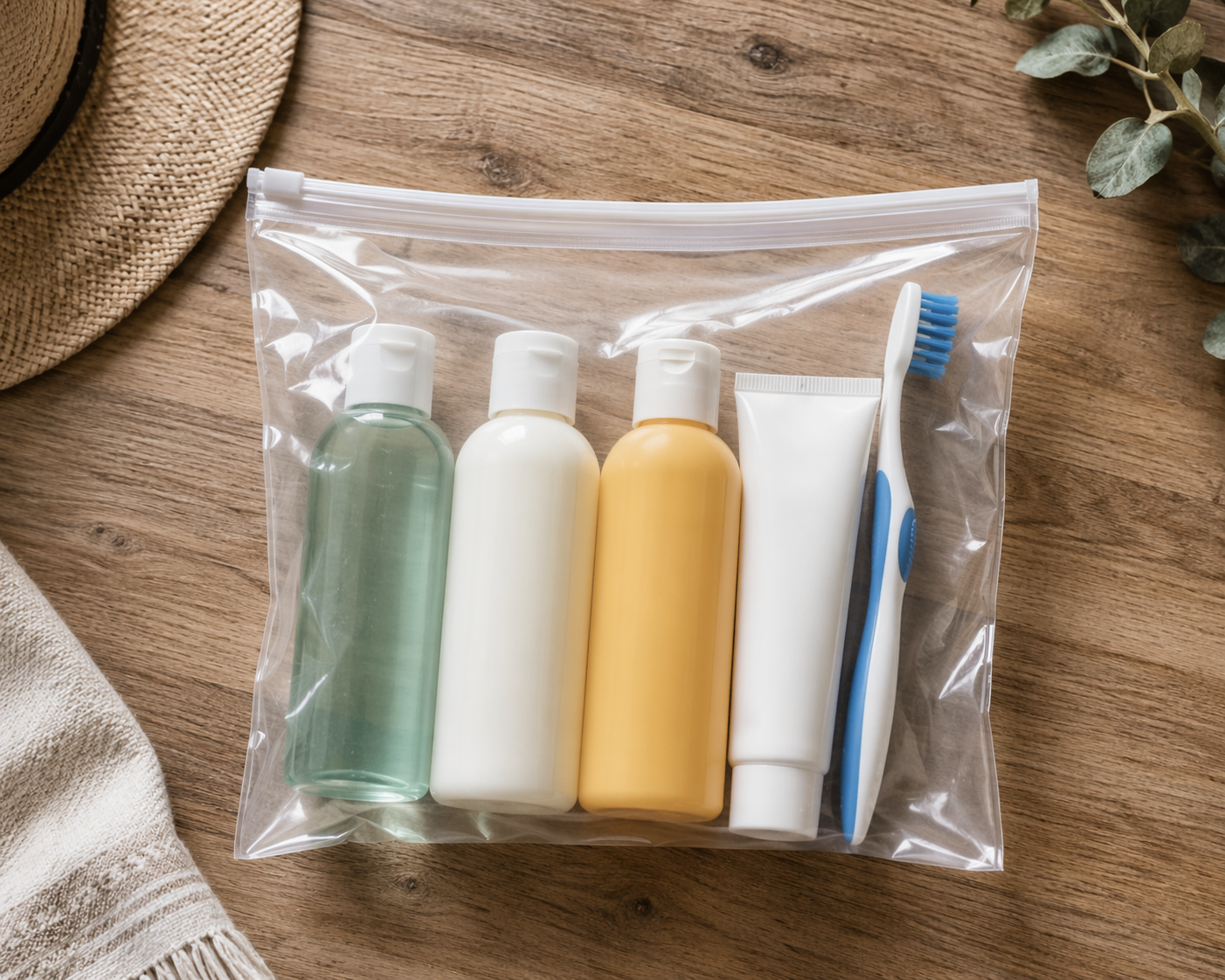
The Rule, Without the Airport Folklore
The name is short because the packing job should be short. The “3” is the maximum container size: 3.4 ounces, or 100 milliliters. The first “1” is one clear quart-size bag, roughly 7 by 8 inches. The second “1” is one bag per passenger.[1]
The bag has to close. Not almost close, not bulge open around a sunscreen tube, not depend on a rubber band in the side pocket. If the quart bag cannot seal, you have too many liquid-like items for a standard carry-on screening.
| Part of 3-1-1 | What it means when packing |
|---|---|
| 3 | Each liquid-like item must be in a 3.4 oz / 100 ml container or smaller. |
| 1 | All compliant containers must fit inside one clear quart-size zip-top bag. |
| 1 | Each passenger gets one liquids bag. |
That table solves most toiletry decisions. If the item spreads, sprays, squeezes, pours, gels, or creams, look at the container size first. If the printed size is over 3.4 ounces or 100 milliliters, it belongs in checked baggage, in a smaller travel container, or at home unless it falls under a documented exemption.
Use This Packing Order
The easiest way to avoid a checkpoint argument is to stop sorting by bathroom category and start sorting by physical form. A toiletry kit is full of things that look ordinary at home and become rule-bound only because of texture.
- Pull out every liquid, aerosol, gel, cream, and paste before you zip the toiletry bag.
- Check the container size printed on each bottle, tube, jar, or can.
- Move only 3.4 oz / 100 ml or smaller containers into the quart-size bag.
- Close the bag completely; if it will not close, remove something.
- Keep exempt items separate enough to show or declare at screening when required.
- Replace easy offenders with solids, or put full-size items in checked luggage.
The mistake that ruins the calm departure is usually not exotic. It is the 6-ounce face wash with one inch left in the bottom, the family-size toothpaste packed because it is already open, or the sunscreen bottle that looks harmless until someone reads the label. TSA’s guidance treats container capacity as the limit, not the amount remaining inside.[2]
What Counts as a Liquid, Gel, Cream, Paste, or Aerosol
The rule is broader than “liquids” in the kitchen-sink sense. TSA applies it to liquids, aerosols, gels, creams, and pastes.[1] In a toiletry bag, that usually includes toothpaste, sunscreen, lotion, shampoo, conditioner, liquid soap, hair gel, shaving cream, perfume, mascara, and contact lens solution. Outside the bathroom, it can also catch items travelers forget are spreadable, such as peanut butter.[1]
Contact lens solution deserves a practical note. It is common, necessary for many travelers, and still a liquid. A small bottle can go in the quart bag. Larger medically necessary quantities may be allowed under the medical exemption, but they should be handled as exempt liquids rather than hidden in the bottom of a toiletries pouch.[3]
Aerosols are not a magic separate category. Travel-size hairspray, spray deodorant, dry shampoo aerosol, and spray sunscreen have to fit the same container-size and quart-bag limits unless another rule applies. The cap, label, and leak risk matter less than the size printed on the container for ordinary toiletries.
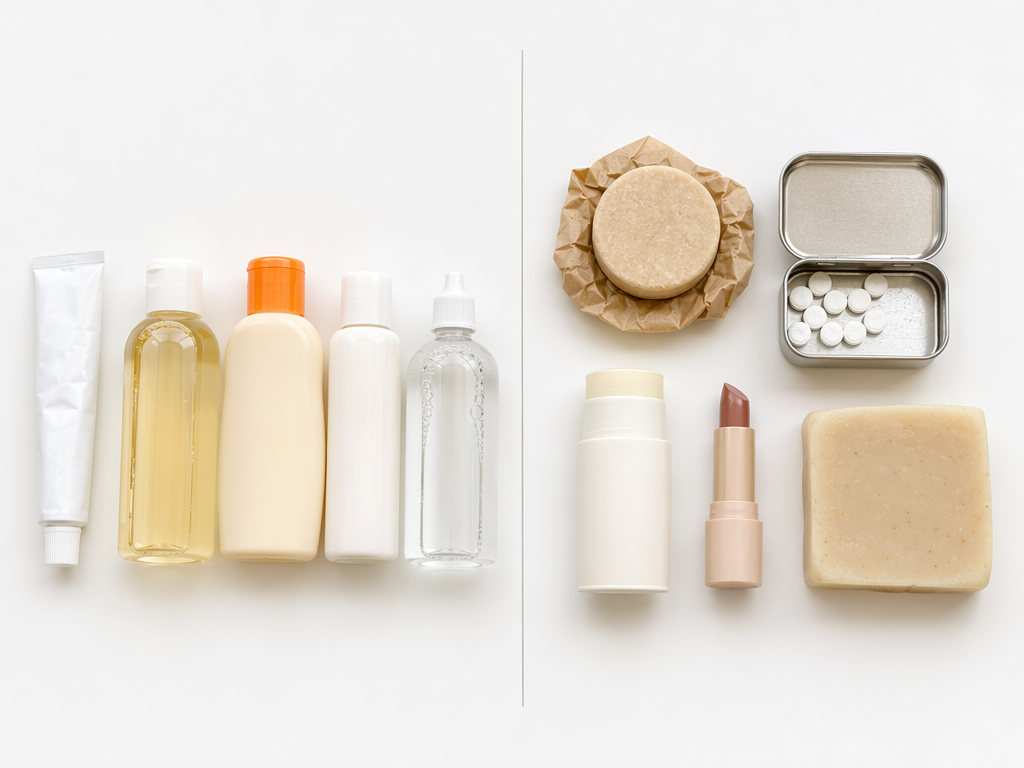
Solids Usually Step Around the 3-1-1 Bag
Solid shampoo bars, bar soap, solid deodorant, toothpaste tablets, lipstick, chapstick, powder makeup within applicable limits, and solid foods do not need to occupy the quart-size liquids bag just because they live in the same toiletry kit.[1][4] This is not a hack; it is the rule doing exactly what it says. The liquid rule applies to liquid-like items.
For short trips, solids are often the cleanest solution. They do not leak, they do not fight for quart-bag space, and they avoid the most common container-size mistake. If you already own a solid deodorant or a shampoo bar that works for your hair, that is one less airport decision.
The Quart Bag Is a Limit, Not a Storage Suggestion
The quart bag is not there to make your suitcase prettier. It is the limit for ordinary carry-on liquids. TSA describes the permitted bag as a clear quart-size bag, and its own guidance gives the approximate size as 7 by 8 inches.[1] A clear zip-top freezer bag, a reusable clear quart toiletry pouch, or another transparent sealable bag can work if it stays within that practical size and closes.
Do not split ordinary toiletries between two small bags and hope the total looks reasonable. The rule is one bag per passenger, not one bag per pocket. Families can use one bag per ticketed traveler, so a parent and child traveling together can each have their own compliant bag.
If you are packing the night before, test the closure before you leave the house. The checkpoint is a poor place to decide which moisturizer you like least.
Exempt Items Are Allowed, but They Are Not Invisible
Some full-size or larger liquid items are allowed in carry-ons because travel does not pause medication schedules, infant feeding, or certain necessary equipment. These allowances are real. They are also conditional. Treat them as items to present clearly, not as loopholes to bury under shampoo.
Liquid Medications
TSA allows medically necessary liquids, medications, and creams in excess of 3.4 ounces in reasonable quantities for a flight, and travelers must tell the officer at the start of screening that they have medically necessary liquids.[3] Prescription labels are not universally required by TSA, but having medication labeled is still a sensible way to reduce confusion, especially when the bottle does not look self-explanatory.[3]
This is where overpacking “just in case” becomes unhelpful. Bring what is reasonably needed for the trip and screening process, keep it accessible, and separate it from the ordinary quart bag. If an officer needs additional screening, that is different from the item being automatically forbidden.
Breast Milk, Formula, Baby Food, and Toddler Drinks
Breast milk, formula, baby food, and toddler drinks are allowed in carry-on baggage in quantities greater than 3.4 ounces, and TSA’s guidance does not require a child to be present for breast milk to qualify.[4] Liquid-filled teethers and cooling accessories used for these items can also fall under the infant-care allowance when packed and screened appropriately.[4]
Pack these items where you can reach them. Tell the officer what they are before screening begins. If you use ice packs, gel packs, or freezer packs to keep them cold, do not assume a half-melted pack will be treated like an ordinary toiletry; medically necessary cooling items and infant-care cooling items have their own allowance, but they still may be inspected.[4]
Frozen Items and Ice Packs
Frozen liquids are generally easiest when they are frozen solid at screening. If an ice pack or frozen item is slushy, partially melted, or has liquid at the bottom, it can be treated as a liquid unless it is needed for a medical or infant-care purpose.[4] The practical packing move is simple: keep truly frozen items frozen, and separate medically necessary cooling supplies from snack-cooler clutter.
Duty-Free Liquids
Certain duty-free liquids over 3.4 ounces may travel in carry-on baggage on international inbound trips if they are packed in a secure, tamper-evident bag, the purchase was made internationally, and the traveler has a receipt showing the purchase was made within 48 hours.[1] That sealed bag is not decoration. Opening it before the final screening point can turn a permitted purchase into a problem.
Odd but Documented Exceptions
Some allowances sound strange only because most travelers never need them: live fish in clear water, biological specimens, and non-spillable wet batteries are examples of items that can be allowed under specific conditions.[4] If one of these is your situation, read the item-specific TSA guidance before you pack. These are not general permission slips for random liquids.
Common Items: Where They Usually Go
| Item | Carry-on packing answer |
|---|---|
| Toothpaste | Counts as a paste; use a 3.4 oz / 100 ml or smaller tube in the quart bag. |
| Sunscreen | Counts as a liquid, cream, or aerosol; container must comply unless checked. |
| Lotion | Counts as a cream; put a compliant container in the quart bag. |
| Shampoo and conditioner | Count as liquids; use travel-size containers or choose bars. |
| Mascara | Counts as a liquid-like cosmetic; place it in the quart bag. |
| Contact lens solution | Counts as a liquid; small bottles go in the quart bag, medically necessary larger amounts should be handled as exempt. |
| Peanut butter | Counts as a spreadable item; follow the 3-1-1 limit in carry-on baggage. |
| Solid deodorant | Usually does not need the liquids bag. |
| Lipstick or chapstick | Usually does not need the liquids bag. |
| Powder makeup | Not part of the liquids bag, though powders can have separate screening considerations. |
The table is intentionally plain because the decision usually is. If it is creamy, squeezable, spreadable, sprayable, or pourable, check the container. If it is a true solid, it generally does not need to compete for space in the quart bag.
Has Anything Changed for 2026?
For ordinary packing, no. The TSA 3-1-1 rule remains in effect across U.S. airports in 2026. What has changed is the screening equipment in many places, not the traveler’s safest packing obligation.
Computed tomography scanners have expanded to about 285 airports, covering roughly two-thirds of screening checkpoints, and some CT lanes may allow travelers to leave their liquids bag inside the carry-on during screening.[5] That does not mean every lane has the same equipment, every airport uses the same procedure, or every officer will handle the bag the same way. A traveler who packs loose full-size toiletries because “the new machines can see them” is gambling with the easiest rule in the airport.
Longer-term changes are possible, but they are not a packing plan for a 2026 trip. Reports citing TSA’s modernization timeline describe full operational capability for CT screening around 2042, which should be read as an estimate rather than a promise that the liquid rule will disappear on a particular date.[6][7]
Why the Rule Exists, Briefly
The liquids rule traces back to the 2006 transatlantic liquid-explosives plot. After an initial liquid ban, the 3-1-1 framework was adopted later in 2006 as a limited way to allow small quantities of liquids back into carry-on bags.[8][9] That history explains the shape of the rule, but it does not make packing more complicated today. The current job is still to manage container size, bag space, and exemptions.
A Calm Final Check Before You Leave
Before the suitcase closes, put the actual quart bag on the counter. Each ordinary liquid-like toiletry should be in a 3.4 oz / 100 ml or smaller container. The clear bag should close. Exempt medications, infant-care liquids, duty-free liquids, or other conditional items should be separate enough to identify and declare when needed. Solids can stay out of the liquids bag unless another screening rule applies.
That is the whole working version of the TSA 3-1-1 rule in Q3 2026: strict on container size, strict on the one-bag limit, narrower than many anxious packers fear, and more generous for medical and infant needs than most “liquids rule” summaries admit. Follow the container label, close the bag, and do not ask a checkpoint officer to rescue a bottle you could have checked at home.
References
- TSA.gov — Liquids, Aerosols, and Gels Rule
- TSA.gov — Liquids/Aerosols/Gels FAQ
- TSA.gov — Medications (Liquid)
- CNTraveler — 11 Full-Size Liquids Allowed
- Forbes — The TSA Is Quietly Phasing Out Liquid Rules, 2025-09-19
- Upgraded Points — Will TSA Liquid Rules Ever Change?
- Travel + Leisure — Learn TSA's 3-1-1 Liquid Rule, 2026 update
- AFAR — TSA's 3-1-1 Rule, 2026 update
- TravelSentry.org — 3-1-1 Liquid Rule Explained
Spotted something outdated?
Report a correction if this explainer no longer matches the current rule. Report a correction.