
Should You Get Global Entry or TSA PreCheck?
Deciding between Global Entry and TSA PreCheck? This comparison shows how your travel patterns determine which program saves you time and money, with a clear decision rule based on whether you fly internationally even once in five years.
TSA · Applies to: Both
Rule last reviewed:
If you expect even one international trip during the five-year membership term, get Global Entry. It costs $120, includes TSA PreCheck, and adds expedited U.S. customs processing when you return from abroad.[1] If you fly strictly within the U.S., do not have a passport, or need the quickest and easiest enrollment path before an upcoming trip, get TSA PreCheck instead.
The price gap is too small to make this a long debate for most international travelers. TSA PreCheck costs $76.75 to $85 for five years depending on the enrollment provider, so Global Entry’s extra cost is $35 to $43.25 across the full term.[2] That is the hinge in the Global Entry vs TSA PreCheck decision.
| Question | Global Entry | TSA PreCheck |
|---|---|---|
| Five-year cost | $120[1] | $76.75-$85, depending on provider[2] |
| What it speeds up | U.S. customs processing after international travel, plus TSA PreCheck security screening benefits[1] | Airport security screening before flights from U.S. airports[3] |
| Does it include TSA PreCheck? | Yes, for eligible members[1] | It is TSA PreCheck only |
| Passport required? | Yes, for U.S. citizens and many applicants; Global Entry is built around international travel documents[3] | No passport required; TSA accepts other approved identity and citizenship documents[3] |
| Enrollment effort | Online application, conditional approval, then an interview; appointment availability can be the bottleneck[4] | Online application, then a short in-person appointment at one of 1,000+ enrollment centers[4] |
| Typical approval timing | CBP says about 80% of applications receive conditional approval within roughly two weeks, but interviews can take weeks or months to schedule[4] | Many applicants receive approval in 3-5 business days, though TSA says some can take up to 60 days[4] |
| Family/minor policy | Minors under 18 may apply free when a parent or legal guardian is already a member or applying[5] | Children 12 and under may generally use the TSA PreCheck lane with an enrolled parent or guardian; older children need their own eligibility[3] |
| Best fit | Travelers who will return to the U.S. from abroad at least once before renewal | Domestic-only travelers, passport-free travelers, or anyone who needs the simpler enrollment path |
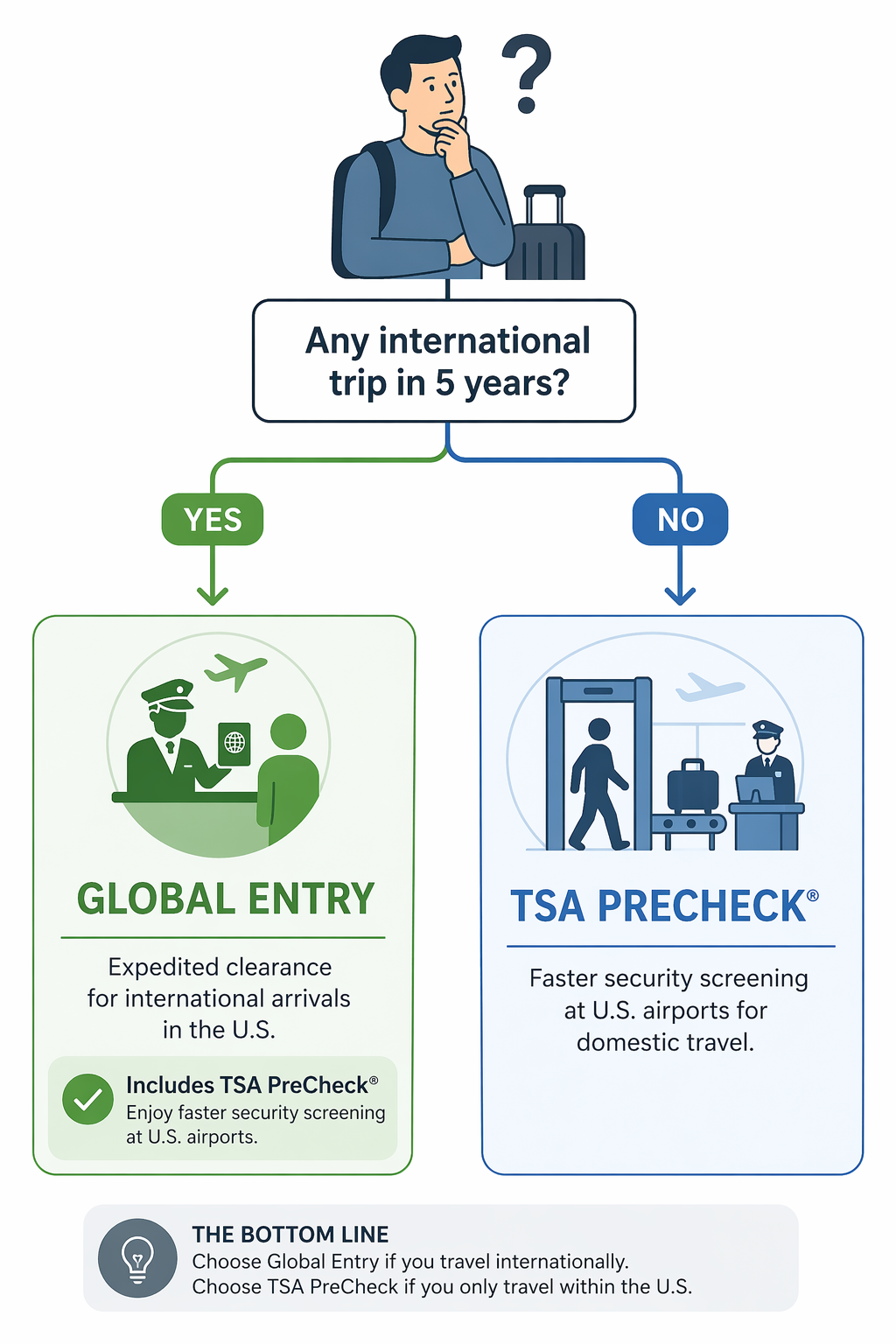
The price math favors Global Entry if you will use it once
Global Entry is not really a rival product sitting beside TSA PreCheck. For eligible travelers, it is the larger bundle: expedited entry after international travel plus TSA PreCheck benefits for airport security.[1] That means the useful question is not “Which program has more benefits?” It is whether those extra international-arrival benefits are worth at most $43.25 over five years.
At the current prices, the answer is usually yes if an international trip is even plausible. Global Entry is $120 for five years.[1] TSA PreCheck is not one single price anymore; as of the current provider pricing cited by NerdWallet, it ranges from $76.75 through IDEMIA to $79.95 through CLEAR and $85 through Telos.[2] Compared with those options, Global Entry costs $43.25 more than the cheapest PreCheck route and $35 more than the most expensive.
That does not make Global Entry “free,” but it does make the upgrade small enough that one international arrival can justify it. The old $100 Global Entry figure still appears in some travel articles, but CBP’s current fee is $120, and that is the number to use for a 2026 decision.[1]
The calculation changes again if you have a card that reimburses the application fee. Many premium and mid-tier travel cards offer a Global Entry or TSA PreCheck statement credit, including cards such as Chase Sapphire Reserve, American Express Platinum, and Capital One Venture X. If the credit covers either program, the marginal price difference can become $0; the remaining question is enrollment effort.
Enrollment friction is the real reason to choose TSA PreCheck
TSA PreCheck is the cleaner choice when you need a fast, domestic-focused answer. The appointment is short, enrollment locations are much more common, and approval often arrives quickly. Forbes Advisor summarizes the PreCheck process as a brief appointment, with many applicants approved in 3-5 business days, though some can take up to 60 days.[4]
Global Entry asks more from you before it gives more back. You apply online, wait for conditional approval, then complete an interview. CBP’s application timing can be reasonable for many applicants, but interview availability is the part that can turn a good theoretical recommendation into a bad practical one. If the next open interview near you is after your trip, Global Entry may not help with that trip at all.
Enrollment on Arrival can reduce that pain if you are conditionally approved and returning from an international trip through a participating airport. Instead of hunting for a separate appointment, you may be able to complete the interview during the arrivals process.[1] That workaround is useful, but it only helps travelers who are already moving through the international-arrival system.
A passport is the other hard stop. Global Entry is an international trusted traveler program, and TSA distinguishes it from TSA PreCheck accordingly.[3] If you do not have a passport and are not planning to get one, TSA PreCheck is the realistic program to pursue.
Families should check the Global Entry minor rule before paying twice
For households, Global Entry’s fee change came with an important offset: as of October 1, 2024, minors under 18 may apply for Global Entry at no cost when a parent or legal guardian is already a member or is applying.[5] That can make Global Entry more attractive for an international-traveling family than the adult fee alone suggests.
The catch is administrative, not mathematical. Each person still needs the right documents and eligibility, and a family has to complete the enrollment work. A parent who can manage one appointment may not be able to easily coordinate several interviews, especially if the nearest Global Entry enrollment center is at an airport several hours away.
What each program actually saves you from
TSA PreCheck helps before departure. You use dedicated screening lanes where available, and the process usually lets you keep shoes, belts, and light jackets on, with laptops and compliant liquids left in your bag.[3] TSA has widely reported that 99% of TSA PreCheck passengers wait less than 10 minutes at airport security.[4]
Global Entry helps after international arrival. Instead of joining the regular passport-control flow, members use Global Entry processing where available and then continue through the arrivals process.[1] It is most valuable when a long-haul flight lands with several other international flights and everyone is trying to reach baggage claim, a connection, a ride, or home.
Neither program gives you immunity from airport judgment calls. TSA and CBP officers retain final discretion, and expedited lanes can be unavailable, redirected, or slower than usual on a bad day. Membership improves your odds of a faster path; it does not create a private right to one.
These are mainstream programs, not niche travel hacks
The enrollment numbers are not the reason to choose one program, but they are useful reassurance. CBP said in May 2025 that nearly 13 million people were enrolled in Global Entry, and the agency also reported processing more than 420 million travelers at ports of entry in fiscal year 2024, up 6.6% year over year.[6]
That scale means a new applicant is choosing between two ordinary airport tools, not signing up for a boutique travel perk.
Where CLEAR fits, and why it does not decide this choice
CLEAR is separate from both Global Entry and TSA PreCheck. It is a private identity-verification service, not a government trusted traveler program, and it does not replace PreCheck screening benefits or Global Entry customs processing.[7] Some travelers stack CLEAR with TSA PreCheck, but that is a different purchase decision.
For this choice, keep the lanes straight: TSA PreCheck is about security before departure, Global Entry is about customs after international arrival and includes PreCheck, and CLEAR is a separate identity lane at participating airports.
Final choice
- Choose Global Entry if you expect at least one international trip before the five-year term ends, have or will get a passport, and can realistically complete the interview.
- Choose TSA PreCheck if your travel is domestic-only, you do not have a passport, you need the simpler enrollment path, or interview availability makes Global Entry impractical.
- Check your credit cards before paying either fee; a statement credit can remove the price difference entirely.
- Use CBP and TSA pages for the final application details, because prices, providers, appointment locations, and eligibility rules can change.
References
- Global Entry, CBP
- TSA PreCheck vs. Global Entry: Which Is Better?, NerdWallet, July 2026
- What is the difference between Global Entry, TSA PreCheck and other Trusted Traveler programs?, TSA
- Global Entry vs. TSA PreCheck: What You Need To Know, Forbes Advisor
- Benefits of Global Entry, CBP
- CBP prepares for summer travel with improved time-saving tools, CBP, May 2025
- TSA PreCheck vs Global Entry vs CLEAR: Which Is Better?, CNBC Select
Ready to enroll?
Spotted something outdated?
Report a correction if this explainer no longer matches the current rule. Report a correction.