
How to Complete Your ESTA Application Correctly in 2026
A clear, step-by-step walkthrough for the ESTA application in 2026, covering fees, eligibility, processing times, and common mistakes so travelers can apply once, correctly.
CBP · Applies to: International
Rule last reviewed:
If you are a Visa Waiver Program traveler, the ESTA application is the online authorization request you complete before traveling to the United States by air or sea. It is usually quick, but it should not be treated like an airport-line formality: U.S. Customs and Border Protection recommends applying at least 72 hours before departure, and an approved ESTA only authorizes travel to a U.S. port of entry. The CBP officer at arrival still makes the final admissibility decision.[1][2]
This guide stays in the practical lane: how to prepare, complete, pay for, save, and check an ESTA application in 2026. It does not try to solve complicated visa history, prior refusal, criminal, immigration, or admissibility questions. If your answer to an eligibility question is not straightforward, slow down and use official guidance rather than guessing.
Before You Start the ESTA Application
| Check | What to know in 2026 |
|---|---|
| Official path | Use the official ESTA application route linked from CBP or USAGov. Be cautious of lookalike websites and inflated service fees. |
| Current fee | $40.27 as of the January 1, 2026 fee adjustment: $10.27 application fee plus $30 authorization fee charged upon approval.[3] |
| Timing | Apply at least 72 hours before departure, even though many applications are processed faster.[2] |
| Passport | Enter passport details exactly as printed. A typo can make the authorization unusable for travel. |
| Each traveler | Every traveler needs a separate ESTA, including infants and children.[2] |
| Validity | An approved ESTA is generally valid for two years or until the passport expires, whichever comes first.[2] |
| Possible result | Authorization approved, authorization pending, or travel not authorized. |

The fee deserves a quick warning because it is one of the easiest ways to spot trouble. Fragomen reported the ESTA fee increase to $40.27 under the 2026 fee changes, and the amount is subject to annual inflation adjustments under the One Big Beautiful Bill Act.[3] Treat that number as current for this article’s verification date, July 14, 2026, not as a permanent price. If a site asks for far more, bundles vague “processing” services, or makes itself look official without being the official route, stop before entering payment details.
The FTC has also warned travelers about ESTA scam websites that charge unnecessary or inflated fees, which is especially easy to miss when someone is rushing before a flight.[4] The safest habit is simple: start from an official U.S. government page, then move to the ESTA application from there.
What to Have Beside You
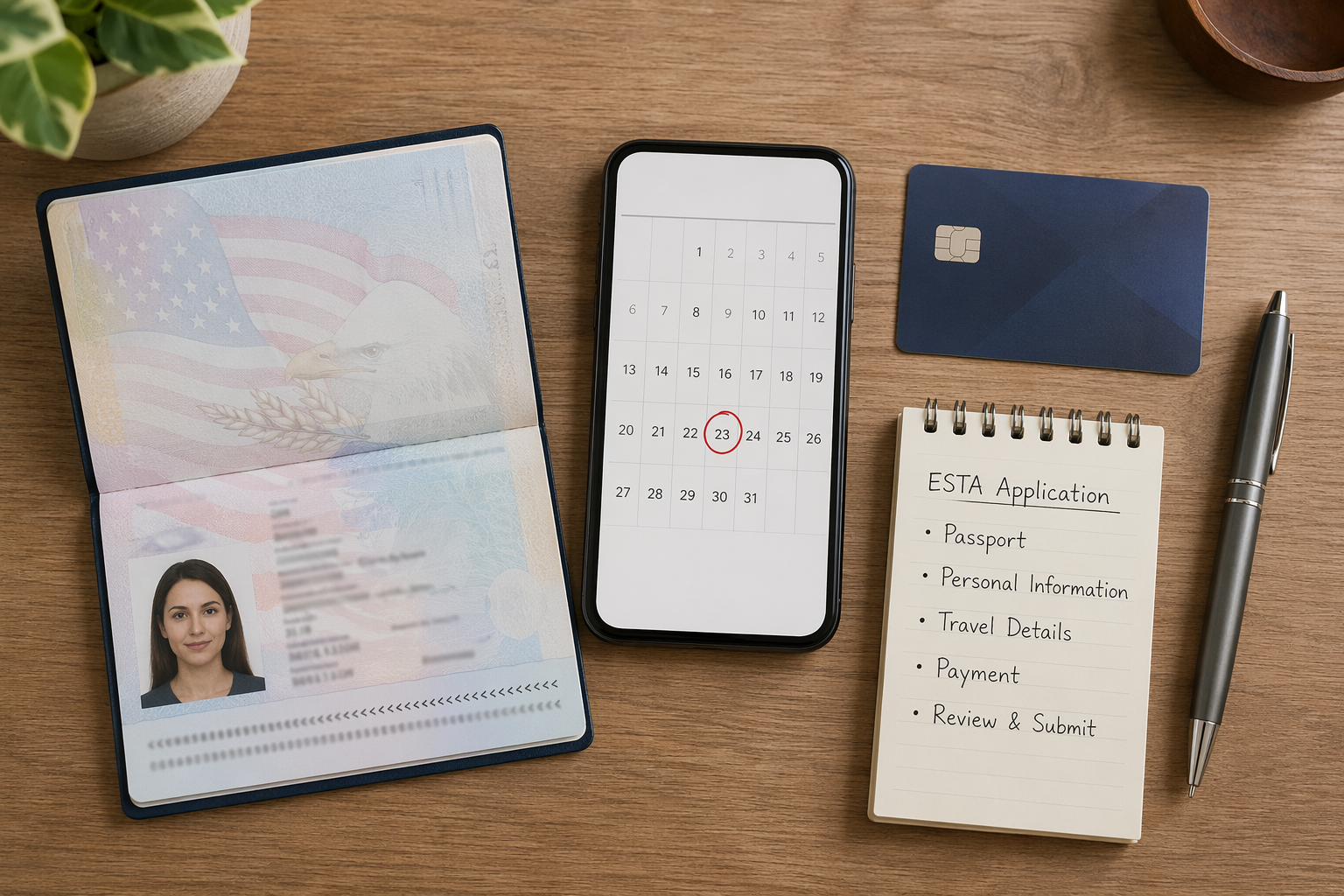
Do not fill the form from memory. Put the passport in front of you and use the printed data page as the source of truth. A saved airline profile, an old photo of a passport, or a previous ESTA confirmation can be useful for orientation, but it should not be what you copy from.
- Your valid passport from a Visa Waiver Program country.
- The exact spelling of your name, passport number, nationality, date of birth, and passport issue and expiration dates as printed.
- A payment card or accepted payment method for the ESTA fee.
- Your email address and contact details.
- Your U.S. travel or address information, if available.
- Enough quiet time to read the eligibility questions without rushing.
If you are applying for several people, keep the passports separated and complete each traveler’s details from that traveler’s document. Family travel does not create one shared authorization. A baby who never holds a boarding pass alone still needs a separate ESTA authorization for Visa Waiver Program travel.[2]
Step 1: Start From the Official Application Path
Begin from CBP’s ESTA information page or USAGov’s Visa Waiver Program ESTA page, then follow the official application link. This avoids the common search-engine problem: sponsored or lookalike pages appearing above the official route. Some third-party sites may submit an application for you, but the traveler is still responsible for the accuracy of the information entered.
Before typing anything, look for signs that you are on a U.S. government application path, not a private travel service dressed in official colors. The fee is a useful cross-check: as of the 2026 adjustment, the official ESTA fee is $40.27, with the $10.27 application portion nonrefundable and the $30 authorization portion charged upon approval.[3]
Step 2: Enter Passport and Identity Details Exactly
This is the part of the ESTA application that looks easiest and causes the most preventable stress. Type the passport number, issuing country, nationality, name, date of birth, sex, and passport dates directly from the passport. Then compare them again before moving on.
Pay special attention to characters that are easy to confuse: the letter O and the number 0, the letter I and the number 1, hyphens, middle names, and long surname fields. If your passport uses multiple given names, do not decide casually that one is “not important.” The ESTA record and passport need to match closely enough for airline and border systems to recognize the authorization.
If the passport will expire soon, remember the ESTA validity rule. An approval normally lasts two years, but it ends earlier if the passport expires first.[2] A new passport generally means the traveler needs a new ESTA tied to the new passport details.
Step 3: Add Travel, Contact, and Employment Details Carefully
The form may ask for contact, travel, and other background details. Use current information where you have it. If your exact U.S. address is not settled yet, follow the instructions available in the application rather than inventing a hotel or borrowing an address from an old itinerary.
For travelers applying before final booking, the practical goal is not to make the trip look more complete than it is. It is to answer the required fields accurately according to the form’s instructions. ESTA is designed to be completed before travel, and CBP’s timing advice points the other way from last-minute improvisation: apply at least 72 hours before departure.[2]
Step 4: Read the Eligibility Questions Slowly
The eligibility questions are not a speed bump to click through. Read each one in full and answer based on your actual circumstances. If a question makes you hesitate, do not choose the answer that seems most convenient just to finish the form. A wrong eligibility answer can create a bigger problem than a delayed application.
This is also where the boundary of a practical guide matters. A straightforward traveler can usually continue by reading the question and answering truthfully. A traveler with a prior refusal, overstay, arrest, immigration issue, or complicated travel history may need official guidance or qualified advice. Repeating the ESTA application with a different answer is not a strategy.
Step 5: Review Before You Pay
The best time to catch an ESTA mistake is before submission, not after the payment screen. Review the application as if someone else typed it. Put the passport beside the screen and compare character by character.
- Passport number matches the passport exactly.
- Name order and spelling match the passport.
- Date of birth is in the correct field and format.
- Passport issue and expiration dates are not reversed.
- Nationality and passport-issuing country are correct.
- Eligibility answers still say what you meant after rereading the full question.
- Email address is accessible, because you may need it for status and confirmation.
For a group application, do this review one traveler at a time. The quiet mistake is copying one person’s detail into another person’s record because the passports are stacked together or a browser autofill intervenes.
Step 6: Pay the ESTA Fee and Save the Application Number
After review, submit the application and pay through the official payment process. The 2026 ESTA fee is $40.27: a $10.27 nonrefundable application fee and a $30 authorization fee that applies when authorization is approved.[3] Because the fee can be adjusted annually, check the amount on the official payment page before paying.
Save the application number immediately. Take a screenshot or download the confirmation if the site offers it, and keep it with your travel documents. You should not rely on being able to reconstruct the application later from memory while boarding or checking in.
Step 7: Check the Status
An ESTA result may appear quickly, but CBP says processing can take up to 72 hours and recommends applying at least 72 hours before departure.[2] That recommendation matters more than anecdotes about approvals arriving in minutes. The traveler who applies early has room to wait; the traveler who applies from the ride to the airport may not.
There are three practical outcomes:
- Authorization approved: you may travel to a U.S. port of entry under the Visa Waiver Program, but admission is still decided by CBP at arrival.[1]
- Authorization pending: the application has not been decided yet. Keep checking through the official status route and do not treat pending as a denial.
- Travel not authorized: you cannot use ESTA for that trip. ESTA denial has no appeal through the ESTA system; the traveler must look to the visa route and official guidance instead.[5][6]
If the status is pending, do not immediately file another application with slightly different information. Duplicate or inconsistent submissions can make the situation messier. Use the application number, check the status through the official route, and allow the stated processing window.
Mistakes That Make an ESTA Application Harder Than It Should Be
Most travelers do not need a dramatic strategy. They need fewer rushed clicks. These are the errors worth guarding against before they become a check-in problem.
Typing the Passport Number From Memory
A passport number is not a phone number; it is not something to approximate. One wrong character can separate the authorization from the document you present at the airport. Use the passport itself, not a saved note, and check it again after autofill or browser translation tools have had a chance to interfere.
Applying Too Close to Departure
The fact that many ESTA applications are processed quickly does not make last-minute filing safe. CBP’s traveler-facing recommendation is at least 72 hours before departure, and that is the timing standard to plan around.[2] If a trip is already booked, submit as soon as the information is accurate enough to complete the form.
Assuming One Family Application Covers Everyone
A group process may make payment or management easier, but it does not erase the individual requirement. Each traveler, including infants, needs their own ESTA authorization.[2] If four people are flying, four passport records need to be correct.
Treating Approval as Entry Permission
ESTA approval lets you travel to a U.S. port of entry under the Visa Waiver Program. It does not guarantee admission to the United States. CBP states this distinction directly, and it is worth keeping in mind before making promises to employers, relatives, cruise operators, or onward travel partners.[1]
Using a Lookalike Website
A private site may look polished and still charge more than necessary. The FTC warning is not theoretical decoration; it exists because travelers searching for ESTA can be steered into sites that profit from urgency and confusion.[4] If you are already anxious, do not let the search results page choose for you. Start from an official government page.
What If Your ESTA Is Denied?
A denial is different from a pending result. Pending means wait and check status. Travel not authorized means ESTA is not available for that trip through that application outcome.
There is no ESTA appeal process for a denial. Practical guidance from immigration and compliance sources is consistent on the next move: the traveler must consider the appropriate visa process rather than trying to appeal inside ESTA.[5][6] That does not mean this article can tell you which visa applies or how a consular officer will view your facts. It means you should stop treating the ESTA form as the tool for that trip until official guidance says otherwise.
Final Pre-Submit Check
Before you pay, pause once. Not for a long legal analysis, just for the checks that actually prevent avoidable trouble.
- You started from an official ESTA path, not a lookalike service site.
- The passport is open beside you, and every passport field matches it exactly.
- Every traveler has a separate application, including children and infants.
- You read the eligibility questions slowly and answered based on your actual circumstances.
- You are applying at least 72 hours before departure whenever possible.
- You understand that approval authorizes travel to a U.S. port of entry, not guaranteed admission.
- You are ready to save the application number and check status through the official route.
The ESTA application is not difficult, but it is unforgiving of sloppy data entry and late timing. The safest version is completed on the official path, checked against the passport, submitted before the 72-hour window becomes urgent, and saved so you can prove the status when travel systems ask for it.
References
- Electronic System for Travel Authorization, U.S. Customs and Border Protection,
- Frequently Asked Questions about the Visa Waiver Program (VWP) and the Electronic System for Travel Authorization (ESTA), U.S. Customs and Border Protection,
- United States: DHS Announces Implementation of New Fees for ESTA, EVUS and Land Border I-94 Forms Starting September 30, Fragomen,
- How to avoid scams while applying for ESTA, Federal Trade Commission, March 2026,
- ESTA application, DavidsonMorris,
- When do you lose ESTA eligibility? 7 situations that end visa waiver travel, Valvo & Associates,
Spotted something outdated?
Report a correction if this explainer no longer matches the current rule. Report a correction.