
How Much Cash You Can Fly With Depends on Your Destination
There is no federal limit on cash for domestic US flights, but international travel requires you to declare any amount over $10,000 to CBP. This article clarifies the two separate rule sets and resolves the common $10,000 myth.
- Applies to
- All airlines
How much cash can you fly with? For a domestic U.S. flight, there is no federal TSA cash limit. For a trip crossing the U.S. border, the familiar $10,000 figure is not a cap; it is a reporting threshold. If you are carrying more than $10,000 in currency or certain monetary instruments into or out of the United States, you must declare it to U.S. Customs and Border Protection.
That split matters because travelers often treat “the airport” as one rule-making body. It is not. TSA screens people and bags for transportation security. CBP handles customs and currency reporting at the border. Airline staff may have their own practical concerns, but they do not turn the $10,000 reporting rule into a domestic cash limit.
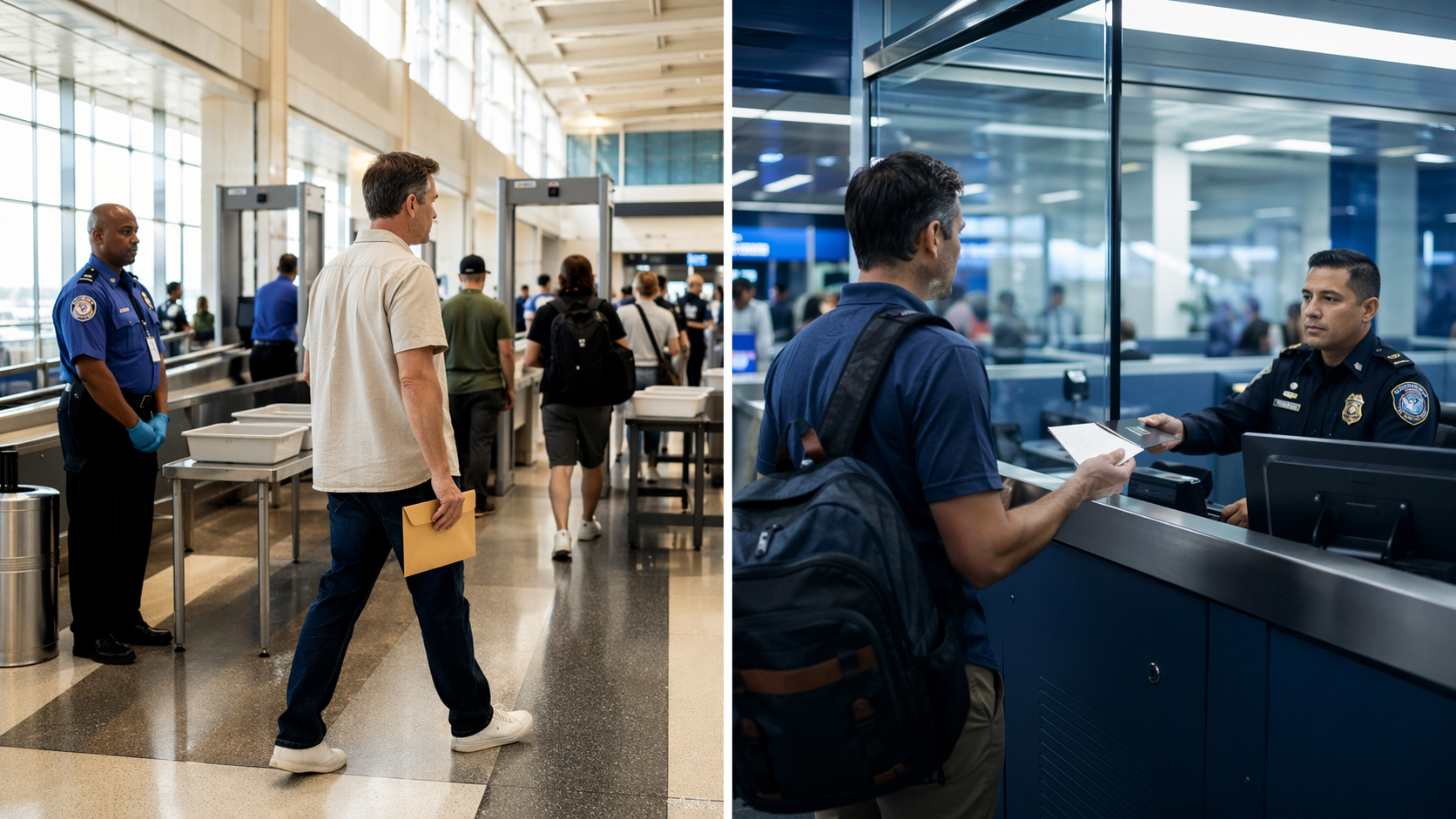
| Trip type | Agency rule that matters | How much cash can you carry? | What you must do |
|---|---|---|---|
| Domestic U.S. flight | TSA screening | No federal TSA cash amount limit is listed for passengers; cash is not treated as a prohibited or restricted item in TSA’s public “What Can I Bring?” framework, and USA.gov states there is no limit on money you can bring on domestic flights. [1] | You do not file a federal cash declaration just because you are flying within the United States. |
| International flight into or out of the U.S. | CBP currency reporting | You may travel with more than $10,000, but amounts over $10,000 in currency or monetary instruments must be reported to CBP. [2] | File FinCEN Form 105 and be prepared to present it to CBP. |
| Family or group traveling together internationally | CBP currency reporting | The threshold applies to the combined total carried by the family or group, not a separate $10,000 allowance for each person. [2] | Count everyone’s cash and report the group total if it is over $10,000. |
Domestic U.S. flights: no TSA cash limit, but not no scrutiny
On a domestic U.S. flight, there is no federal rule that says you may carry only $10,000, or only any other fixed amount, in cash. USA.gov puts the domestic answer plainly: there is no limit on the amount of money you may bring on a domestic flight. [1]
TSA’s public “What Can I Bring?” system is built around items that are allowed, restricted, or prohibited at screening. Cash does not appear there as a prohibited or restricted item. That is a narrower statement than “TSA promises unlimited cash is always fine.” The practical conclusion is still important: TSA is not the agency imposing a domestic cash amount limit.
This does not mean a large stack of bills will pass through an airport with no attention. TSA officers may notice cash during screening. If they think something about the circumstances suggests criminal activity, they can refer the matter to law enforcement. The distinction is not academic: TSA screening is not the same thing as a cash seizure rule.
For domestic travel, the sensible preparation is not a declaration form. It is documentation. If you are carrying legitimate cash for a vehicle purchase, family support, relocation, payroll, a private sale, or an emergency, keep records that explain the source and purpose of the money: withdrawal slips, sale documents, invoices, business records, or written context that matches what you can explain calmly if asked.
International travel: the $10,000 rule belongs here
The $10,000 number is a CBP reporting threshold for international travel. If you transport, mail, ship, or cause to be transported more than $10,000 in currency or monetary instruments into or out of the United States, you must report it to CBP. CBP also states that members of a family or group traveling together must report the combined total if it exceeds $10,000. [2]
Reporting is not the same as asking permission to carry the money. A traveler may lawfully carry more than $10,000 across the U.S. border, but the amount must be declared. The mistake is treating the threshold as a maximum. The more dangerous mistake is splitting cash among family members and assuming each person has a separate undeclared allowance.
For this rule, “cash” is not limited to U.S. dollar bills. Currency and monetary instruments can include U.S. and foreign currency, traveler’s checks, money orders, bearer bonds, and negotiable instruments payable to bearer. Credit cards, personal checks, and gold bullion are not treated the same way for this particular cash-reporting rule. [3]
How to declare more than $10,000
The form used for U.S. border currency reporting is FinCEN Form 105. The online FinCEN Form 105 portal says travelers may file the form up to 72 hours before travel. After filing, keep a copy and present it to the CBP officer when required, whether you are arriving in or departing from the United States. [4]
- Add up the full amount carried by you and anyone traveling with you as a family or group.
- Include covered monetary instruments, not just paper bills.
- File FinCEN Form 105 before travel when possible.
- Keep a copy accessible with your travel documents.
- Answer CBP questions consistently with the form and your supporting records.
The form is not busywork. Failure to declare can lead to seizure of the full amount and severe penalties. Legal sources summarizing federal currency-reporting consequences describe possible fines up to $500,000 and imprisonment for up to 10 years for non-declaration, while concealment can create separate bulk cash smuggling exposure under 31 U.S.C. 5332. [5][6]
Legal cash can still create airport problems
A traveler can be within the cash amount rules and still be questioned. Large amounts of currency are portable, hard to trace, and often treated by enforcement agencies as a risk signal. That does not make the money illegal. It does mean the traveler carrying it may need to explain where it came from and why it is being transported.
CBP currency seizures are not theoretical. One analysis of CBP published data counted 9,754 currency seizure events totaling $222.6 million across fiscal years 2022 through 2025. [7] That figure does not say that ordinary travelers carrying documented money are likely to lose it. It does show why “allowed” is not the same as “will never be challenged.”
Concealment is especially bad risk management. Packing cash in a normal carry-on pocket, envelope, or money belt is different from hiding it in a false compartment, wrapping it to avoid detection, or giving inconsistent explanations about who owns it. If the money is legitimate, the goal is to make the legitimate story easy to verify, not harder.
There is also a recent enforcement backdrop worth knowing, without turning it into the whole story. The Drug Enforcement Administration ended its Transportation Interdiction Program in January 2025 after an Inspector General report found the program’s warrantless airport gate searches violated Fourth Amendment rights. [8] That change does not erase civil asset forfeiture risk, but it is a reminder to identify the actual agency and actual authority involved instead of assuming every airport encounter follows the same rulebook.
A quick decision path before you fly
| Your situation | What to do |
|---|---|
| You are flying only within the United States. | There is no federal TSA cash amount limit. Carry records showing the lawful source and purpose of large sums, and do not conceal the money in a way that creates suspicion. |
| You are entering or leaving the United States with $10,000 or less. | A CBP currency report is not required solely because of that amount, though CBP may still ask routine questions at the border. |
| You are entering or leaving the United States with more than $10,000. | Declare it to CBP using FinCEN Form 105. The money is not banned because it exceeds $10,000; the reporting requirement is the point. |
| You are traveling internationally as a family or group. | Count the combined total. Do not treat the threshold as a separate allowance for each traveler. |
| You are connecting through or arriving in another country. | Check that country’s official customs rules before travel. Other countries may use different thresholds and forms. |
The clean answer is this: domestic U.S. flights have no TSA cash limit; international U.S. border crossings require a CBP declaration when the covered total is more than $10,000; and in both settings, large unexplained cash can draw questions. Once those three ideas are separated, the airport rule becomes much less mysterious.
References
- Travel money — USAGov
- Money and Other Monetary Instruments — U.S. Customs and Border Protection
- Flying with Cash — Alternative Airlines
- FinCEN Form 105 CMIR, U.S. Customs and Border Protection — U.S. Customs and Border Protection
- Can TSA Seize Cash? Understanding Your Rights When Traveling with Money — Meltzer & Bell
- Airport Cash Seized? Civil Forfeiture Guide — My Rights Law
- CBP Cash Seizure Data Report — Great Lakes Customs Law
- DEA Ends Airport Gate Searches After Years of Documented Abuses of Civil Asset Forfeiture — Reason, January 16, 2025
Figure out of date?
Airline fees and size limits change without much notice — let us know if something here looks stale. Report a correction.