
How Early to Arrive at the Airport? 5 Factors to Consider
A five-variable framework replaces the generic '2 hours domestic' rule, letting you calculate your optimal airport arrival time based on your checked bag, PreCheck status, airport size, time of day, and current travel period.
This topic does not have a single fixed number — see the reasoning below for how to estimate your own buffer.
arrival-time · domestic, international
If you are asking how early to arrive at the airport, start with the part that can actually end the trip before security ever matters: the airline’s bag-drop deadline. American Airlines and Delta both list 45-minute domestic and 60-minute international checked-bag cutoffs for many U.S. departures, though other carriers and airports can set different rules.[1][2] The table below is estimated guidance, not an official personalized arrival-time dataset.
| Your situation | Estimated airport arrival window |
|---|---|
| Carry-on only + TSA PreCheck, familiar midsize airport, off-peak | 60–75 minutes before departure |
| Carry-on only + TSA PreCheck, large hub or long gate walk | 75–90 minutes before departure |
| Carry-on only, no PreCheck, standard security line | 90–120 minutes before departure |
| Checked bag, domestic flight | 120 minutes before departure; more if the counter is likely to be busy |
| Checked bag, international flight | 150–180 minutes before departure |
| Family, infrequent flyer, unfamiliar airport, or mobility constraints | Add 30–45 minutes to the closest row above |
| Peak holiday, major event, World Cup host-city pressure, or early-morning rush | Add 30–60 minutes if the airport or date is affected |
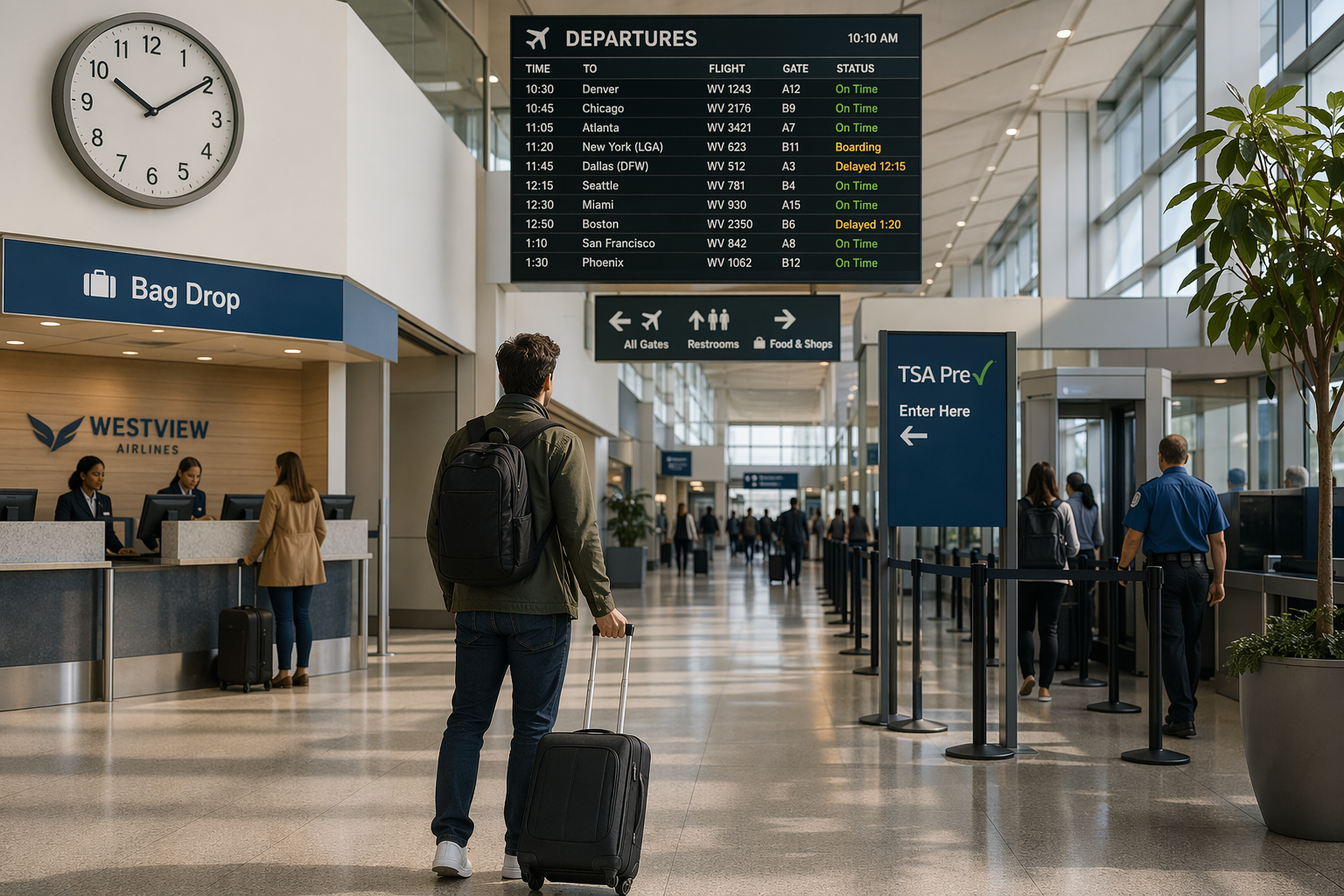
The old “two hours domestic, three hours international” rule is not useless. It is just too blunt. The better question is which clock applies to you: bag drop, security, walking distance, peak-period crowding, or current demand. Those clocks do not move together.
The Checked Bag Is the Hard Stop
A long security line can make you nervous. A closed bag counter can make the flight impossible. That is why checked luggage deserves first place in the calculation.
American Airlines tells passengers that checked bags must be presented at least 45 minutes before departure for many domestic flights and 60 minutes before international flights.[1] Delta lists the same 45-minute domestic and 60-minute international minimums for many departures.[2] These are not suggested arrival times. They are cutoff times. If you reach the counter at 44 minutes with a suitcase, the rest of your plan may no longer matter.
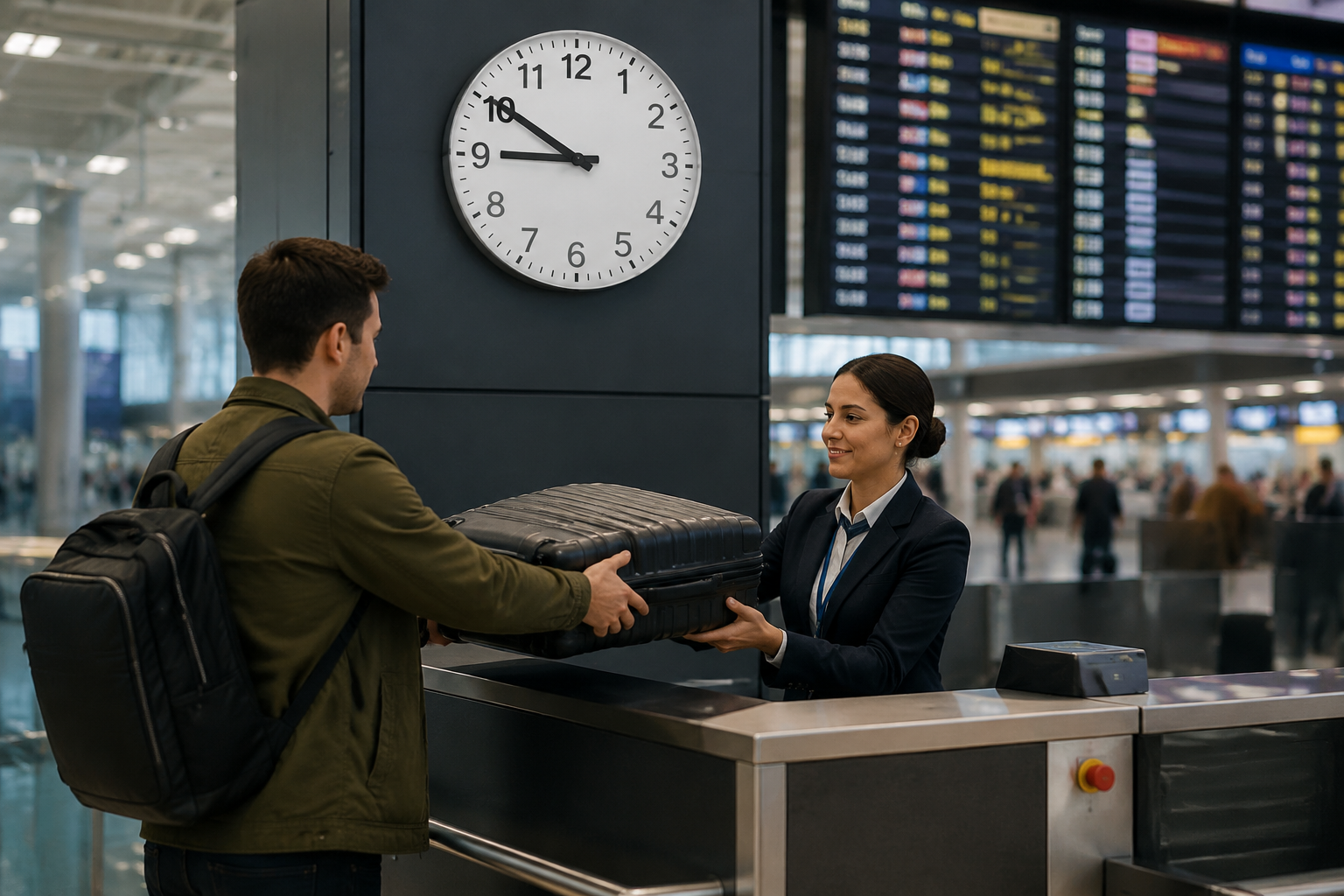
The trap is that “45 minutes” does not mean “arrive at the curb 45 minutes before departure.” It means the airline has accepted the bag by then. Before that moment, you may still need to find the right terminal, wait for a kiosk, print or fix a tag, stand in a bag-drop line, show ID, or deal with an overweight bag. A traveler who planned around a security wait average can still lose time at the first counter.
For a domestic flight with a checked bag, two hours is still a reasonable starting point at many U.S. airports. At a small airport in a quiet period, it may feel padded. At a hub during a morning bank of departures, it may not be generous. For international flights with checked bags, 150 to 180 minutes is more defensible because the bag cutoff is later, document checks can add another counter step, and the departure gate may close earlier than the printed departure time suggests.
Do not copy American or Delta’s cutoff to every airline. Low-cost carriers, international carriers, and airport-specific operations can differ. The practical move is simple: check your airline’s cutoff, then work backward from the moment the bag must be accepted, not from the moment you hope to join the security line.
When 60 Minutes Can Be Enough
A 60-minute airport arrival is not reckless in every case. It is reckless when people borrow it without borrowing the conditions that make it work.
TSA PreCheck is the main reason the lower end of the table exists. TSA data cited by CNBC says 99% of PreCheck passengers waited under 10 minutes in February 2026.[3] That does not mean every PreCheck traveler can treat the airport like a train platform, but it does remove a large chunk of uncertainty when the lane is operating normally.
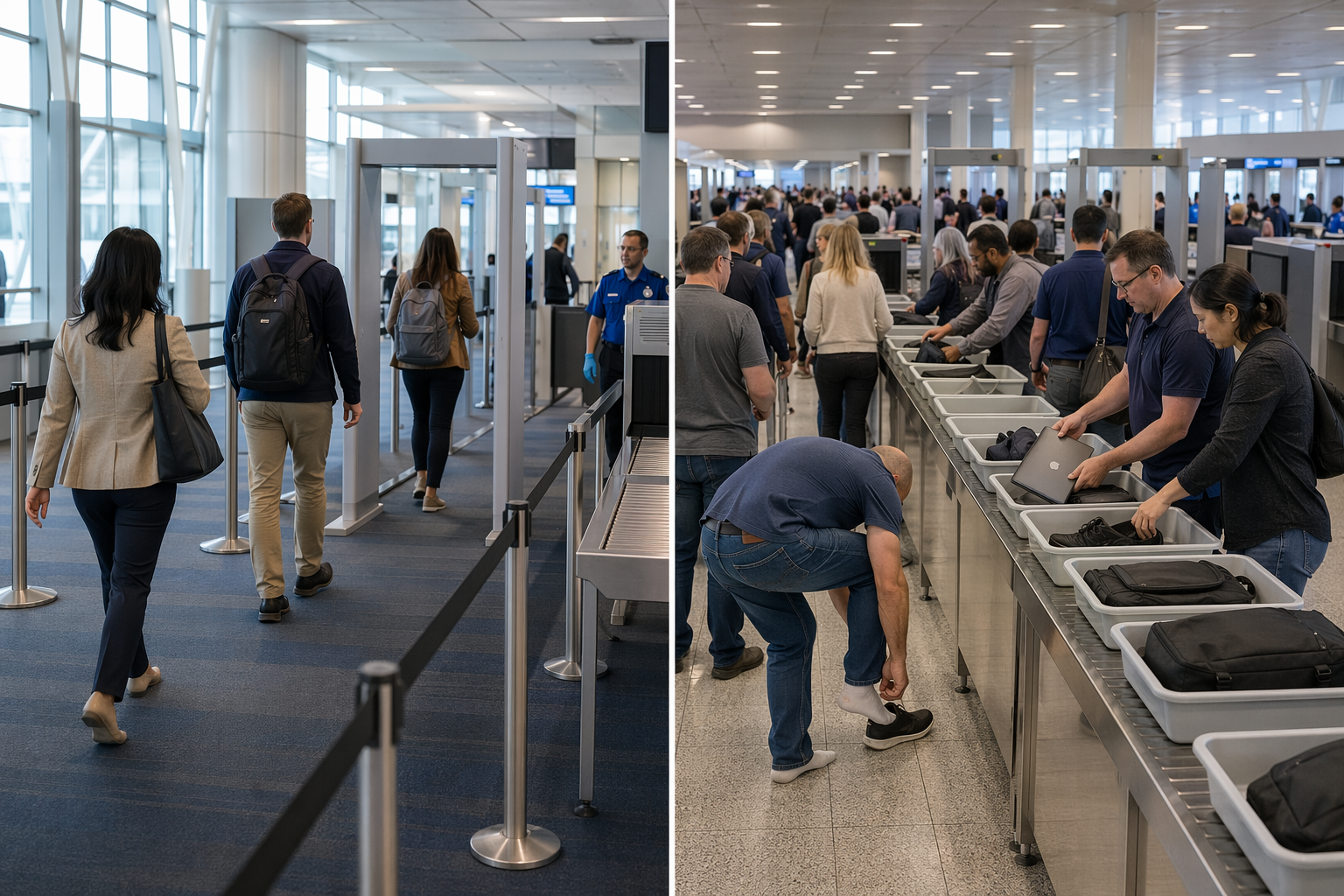
Nate Silver’s personal flight log is useful here because it describes an actual behavior pattern rather than a vague preference. He reported tracking roughly 800 flights, usually arriving about 60 minutes before departure when flying with PreCheck and carry-on luggage, with a missed-flight rate of about 0.5%.[4] That is a real data point, and also a narrow one: experienced traveler, carry-on only, PreCheck, and habits shaped heavily by airports he knows.
So the 60-minute version should be reserved for a fairly specific traveler: no checked bag, boarding pass already handled, PreCheck active on the reservation, familiar terminal, normal weather and traffic, and no obvious peak-period complication. Remove one of those conditions and the buffer should grow. Remove several, and the “efficient” plan becomes a tight connection with extra steps.
Clear is more conditional. At some airports it can bypass the ID-check bottleneck and save meaningful time. At others, a congested Clear enrollment or verification area can be slower than walking straight into a short PreCheck lane. Treat Clear as a possible improvement, not as an automatic reason to cut your airport arrival time.
Airport Size Changes the Walk, Not Just the Line
Security averages are helpful, but they can hide the airport’s physical problem: distance. A regional airport may put ticketing, security, and the gate within a short walk. A large hub can turn a perfectly acceptable TSA wait into a long terminal transfer, train ride, or far-concourse march.
An Upgraded Points analysis of 25 major U.S. airports found average TSA waits ranging from 9.1 minutes at Salt Lake City to 23.1 minutes at Newark, based on a 56-day spring window.[5] Those exact numbers should not be treated as a live forecast for your departure. Their better use is comparative: the security line is often only one part of the airport-time spread, and the slowest-feeling airports are not always slow only because of TSA.
For a large hub such as JFK, ATL, ORD, EWR, LAX, or DFW, adding 15 to 30 minutes over a midsize-airport estimate is often the cleaner choice, especially if you do not know the terminal. That buffer is not for sitting near the gate. It is for the moments that do not show up in a TSA wait chart: wrong curb, terminal train, remote checkpoint, long escalator detour, gate change, or a boarding area that is farther away than the map made it look.
Time of Day Can Move the Recommendation by Half an Hour
Airport timing gets worse when too many flights, commuters, rideshares, and bag drops meet at once. Nationally, early morning and midday are commonly busy TSA periods; locally, the airport’s airline schedule can matter even more.
Gad Allon’s Philadelphia International Airport case study is useful because it shows magnitude without pretending to be a universal calculator. In his model, the recommendation for a leisure traveler was 53 minutes in an off-peak period and 90 minutes in rush hour, a difference of roughly half an hour at the same airport.[6]
That does not mean every rush-hour departure needs exactly 37 extra minutes. It means peak timing deserves its own adjustment. If your flight leaves between 5 and 8 a.m., during a midday bank, on the Friday before a holiday, or right after a major local event, do not rely on the same airport arrival time you would use for a quiet Tuesday evening.
July 2026 Is Busy, Not March 2026 All Over Again
Some of the current anxiety is understandable. In March 2026, travelers saw reports of severe TSA disruption, including unusually long waits and staffing strain; NPR described the period as producing the longest TSA wait times in the agency’s history.[7] NBC News also reported that some airports and airlines changed arrival-time guidance during that disruption.[8] That history explains why people are searching nervously. It should not be treated as the normal July baseline.
As of July 2026, TSA’s daily checkpoint volume is running in the roughly 2.5 million to 2.9 million passenger range, which is heavy summer travel rather than a repeat of the March crisis.[9] Heavy does not mean easy. It means the basic table still needs seasonal judgment: school breaks, holiday weekends, storm systems, and large events can stack pressure onto an airport that is otherwise functioning normally.
The FIFA World Cup adds one more localized reason to check your date and airport rather than panic broadly. If you are flying from a host city on a match day, near a major fan event, or during a peak international arrival-and-departure window, add 30 to 60 minutes. If you are leaving a non-host regional airport on an ordinary weekday, the World Cup is not a reason by itself to turn a 90-minute plan into a three-hour one.
The 30-Second Adjustment
Use the table as the starting point, then adjust only for variables that can actually cost you time.
- Checked bag: build the plan around the airline’s bag-drop cutoff, then add counter-line buffer.
- PreCheck: reduce security uncertainty only if PreCheck is active on your boarding pass and the airport has a functioning lane.
- Airport size: add time for large hubs, unfamiliar terminals, long walks, or terminal transfers.
- Time of day: add time for early morning, midday peaks, holiday Fridays, and local rush periods.
- Current demand: add time for summer peaks, host-city event pressure, storms, or airline disruption alerts.
That is the real replacement for the old rule. Not “always arrive earlier,” and not “60 minutes is fine if you are confident.” A checked bag, a standard security lane, a large unfamiliar hub, a peak departure bank, or a high-demand travel period each earns its own minutes. If none of those apply, you can often avoid dead time. If several apply at once, the airport clock is already tighter than it looks.
References
- Check-in and arrival, American Airlines,
- Check-in Times at U.S. Airports, Delta Air Lines,
- TSA wait times: What to know before you go, CNBC,
- I’ve tracked my last 800 flights. Here’s when you really need to get to the airport, natesilver.net,
- The U.S. Airports With the Shortest and Longest TSA Wait Times, Upgraded Points,
- Newsvendor model, Gad Allon Substack,
- Travelers are facing the longest TSA wait times in history, NPR,
- U.S. airports changing arrival time guidance, NBC News,
- TSA checkpoint travel numbers, Transportation Security Administration,
Does this not match what you experienced?
Especially for connection-time estimates, we want to hear about it. Report a correction.